


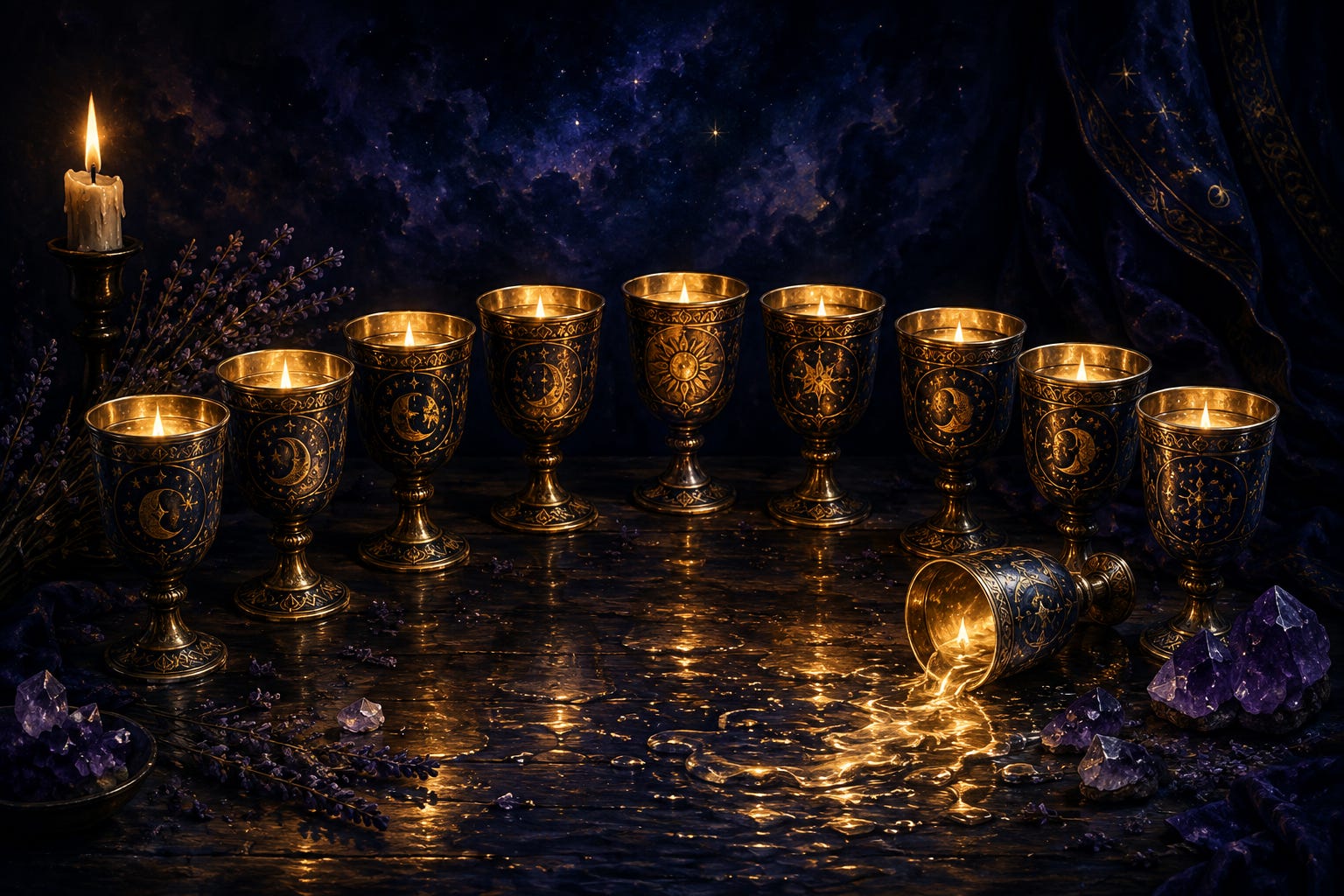
Cups are the suit everybody hopes to see, and roughly half of them are not what people expect.
The Five is grief. The Eight is walking away from something that was working. The Seven is a head full of options and no decision in it. Cups are the water suit, and water is not only calm. It is every feeling you have, including the inconvenient ones.
There are fourteen Cups in a tarot deck. This guide covers the ten numbered cards, Ace through Ten. The four faces, Page, Knight, Queen and King, have their own guide: Tarot Court Cards, Fully Explained.
What the suit of Cups means
Element: water. Emotion, relationships, intuition, creativity, and the inner weather of a life. Where Pentacles ask what something costs and Swords ask what is true, Cups ask how it feels and who it involves.
In a playing deck, Cups are Hearts. That mapping is old and it is a useful shortcut when you are learning: the suit of the heart, in every sense the word carries.
If a reading comes out mostly Cups, the situation is emotional at its core, whatever the querent asked about. A question about a job that answers in Cups is not really about the job. It is about the people in it, or how the person feels being there.
How the numbers work
Every suit runs the same shape, which is the single most useful thing to learn early. Once you know the numbers, three quarters of the Minor Arcana stops being memory work.
Ace is the seed. Two is the pair. Three is the group. Four is the pause, and usually the stall. Five is the loss. Six is the past. Seven is the choice. Eight is the departure. Nine is the arrival. Ten is the whole thing, finished.
Read that shape through water and you get the suit of Cups almost without being told: a feeling begins, becomes a pair, becomes a circle of people, stalls, breaks, remembers, gets confused by options, leaves, arrives, and finally comes to rest.
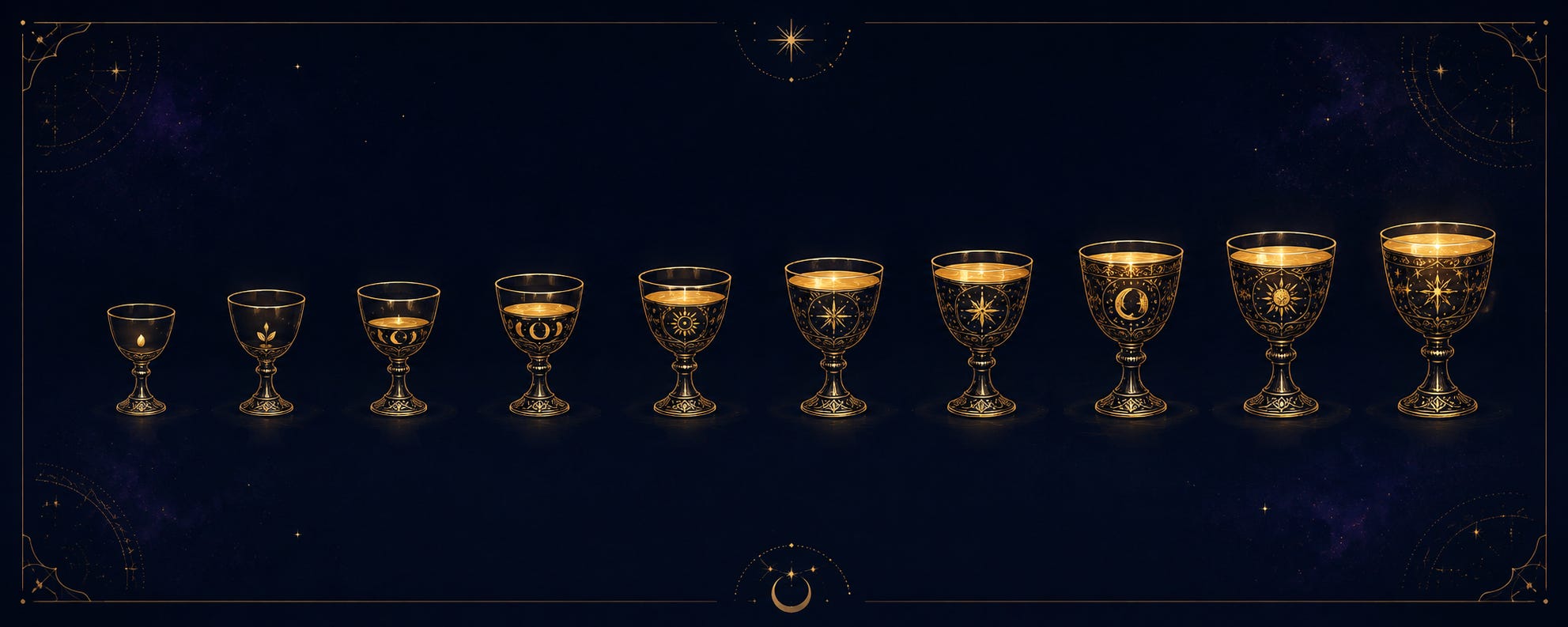
All 10 Cups, card by card
Ace of Cups
Upright. A new feeling arriving, and an open channel for it. Love offered, creativity welling up, the cup filled to the brim before you have done anything to earn it.
Reversed. A feeling held back. Emotion with nowhere to go, or an offer you are not yet able to accept.
In a reading. The Ace is a beginning, not a relationship. It shows the possibility opening. What happens after that is the other cards’ business.
Two of Cups
Upright. Mutual attraction, partnership, and an equal exchange. Two people meeting each other properly rather than approximately.
Reversed. Imbalance, a connection out of step, or a bond that needs repair rather than an ending.
In a reading. The Two is not always romance. It is any relationship where both sides are genuinely present. Reversed, it usually means one person is carrying more of it than the other.
Three of Cups
Upright. Celebration, friendship, community, and the particular joy of being among your own people.
Reversed. Overindulgence, gossip, a third party in a situation built for two, or a friendship group that has quietly turned draining.
In a reading. This is the group chat card. Upright it is support. Reversed it is often the same group, and the trouble is that everybody knows everything.
Four of Cups
Upright. Apathy, boredom, and an offer ignored while somebody stares at what they already have.
Reversed. Waking up, accepting the offer, or the fog of disinterest beginning to lift.
In a reading. Look at the fourth cup in the picture, the one being held out that nobody is looking at. The Four is rarely about lack. It is about attention.
Five of Cups
Upright. Grief, regret, and attention fixed on what spilled instead of what is still standing.
Reversed. Acceptance, moving forward, or a first glance back over the shoulder at what remains.
In a reading. Two cups are still upright behind the figure. Every reading of this card should mention them. The loss is real, and it is not the whole picture.
Six of Cups
Upright. Nostalgia, childhood, innocence, and kindness given without calculation.
Reversed. Living in the past, or an idealised memory getting in the way of the present.
In a reading. The Six often appears around someone from earlier in a life. It rarely means they are coming back. More often it means their influence never actually left.
Seven of Cups
Upright. Choices, fantasy, and too many options presented at once, most of them illusions.
Reversed. Clarity arriving, or a decision finally made after far too long spent browsing.
In a reading. The Seven is the open-tab card. Nothing is wrong except that nothing has been chosen, and the choosing is the entire task.
Eight of Cups
Upright. Walking away. Leaving something behind that is not bad, only finished.
Reversed. Hesitating at the threshold, turning back, or leaving without admitting the real reason.
In a reading. The hardest card in the suit, because what is being left is usually fine. The Eight is about outgrowing something, not escaping it.
Nine of Cups
Upright. Contentment, satisfaction, and a wish granted. Readers have called it the wish card for a century.
Reversed. Getting exactly what you asked for and finding it hollow, or a pleasure papering over something else.
In a reading. Upright it is genuinely good news. Reversed it asks a sharper question, which is whether the wish was ever the real one.
Ten of Cups
Upright. Emotional fulfilment, harmony, home, and the whole picture rather than one good moment.
Reversed. A gap between the picture and the reality, or a family harmony that takes work nobody sees.
In a reading. The Ten is the long view, where the Two is the moment. Reversed, it usually means somebody is comparing their real life to another person’s postcard.
The four court Cups
Page, Knight, Queen and King of Cups are people, or the parts of a person that behave like people. They follow different rules from the numbered cards, and they trip up more beginners than anything else in the deck. They have their own full guide: Tarot Court Cards, Fully Explained.

Reading Cups next to other suits
A Cup beside a Sword is feeling meeting a hard fact. A Cup beside a Pentacle is feeling meeting a practical cost. A Cup beside a Wand is feeling meeting momentum, which usually accelerates whatever the Cup was already doing.
That interaction has a name and a set of rules, and it is the thing that turns a row of separate meanings into an actual reading. We covered it here: Elemental Dignities: How the Cards Talk to Each Other.
Frequently asked questions
What element is the suit of Cups?
Water. It governs emotion, relationships, intuition and creativity. In a playing card deck the same suit is Hearts.
What do Cups mean in a tarot reading?
They point at the emotional layer of a situation: how somebody feels, who else is involved, and what the relationship between them is doing. They rarely answer questions about money or timing directly.
Are Cups good cards?
Not automatically. The Five is grief, the Eight is a departure, the Seven is self-deception. Cups describe feeling, and feeling is not always pleasant. Treating the suit as uniformly positive is the most common beginner error with it.
What does it mean if I pull lots of Cups?
That the question is emotional underneath, even if it was not asked that way. Several Cups in a small spread usually mean the practical detail the querent raised is not the real subject.
Which Cup is the wish card?
The Nine. It has been read as the wish granted for well over a hundred years. Reversed, it is worth asking whether the wish being granted was the one that actually mattered.
Learn the whole deck
Astra Trainer teaches all 78 cards in short daily lessons, with drills that make the meanings stick instead of sliding off. Five minutes a day, free to start.
Related guides: Learn Tarot (start here) · How to Read Tarot Cards · Major Arcana Meanings · Reversed Tarot Cards
Each Cup also has a page of its own. The full card reference covers all 78 cards, upright and reversed.