


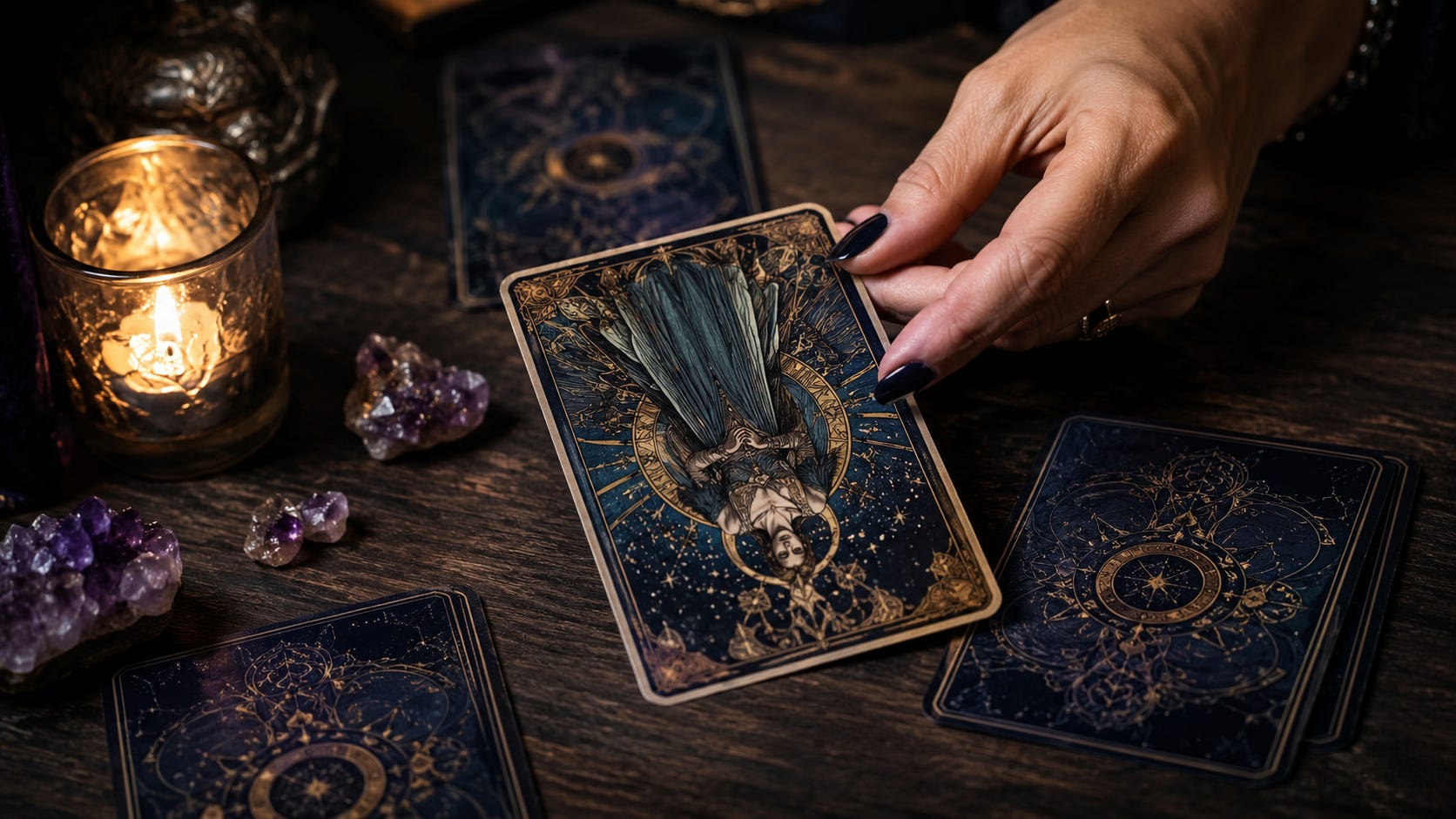
A reader called Shannon told us that reversals lock her up. The card lands upside down, her mind empties, and she is suddenly certain she is doing tarot wrong.
If that is you, you are in enormous company. It is the single most common place readers stall, and it stops beginners and experienced readers alike.
The good news is that the freeze is caused by one bad rule almost everybody was taught, and once you drop it the problem mostly dissolves.
Why reversed cards freeze people
Most of us picked up somewhere that a reversal means the opposite of the card. Upright is joy, so reversed must be misery. Upright is success, so reversed must be failure.
That rule is where the panic comes from. It turns half your deck into landmines, and it quietly doubles the workload, because now you believe there are 156 cards to learn instead of 78.
Here is the reframe that fixes it.
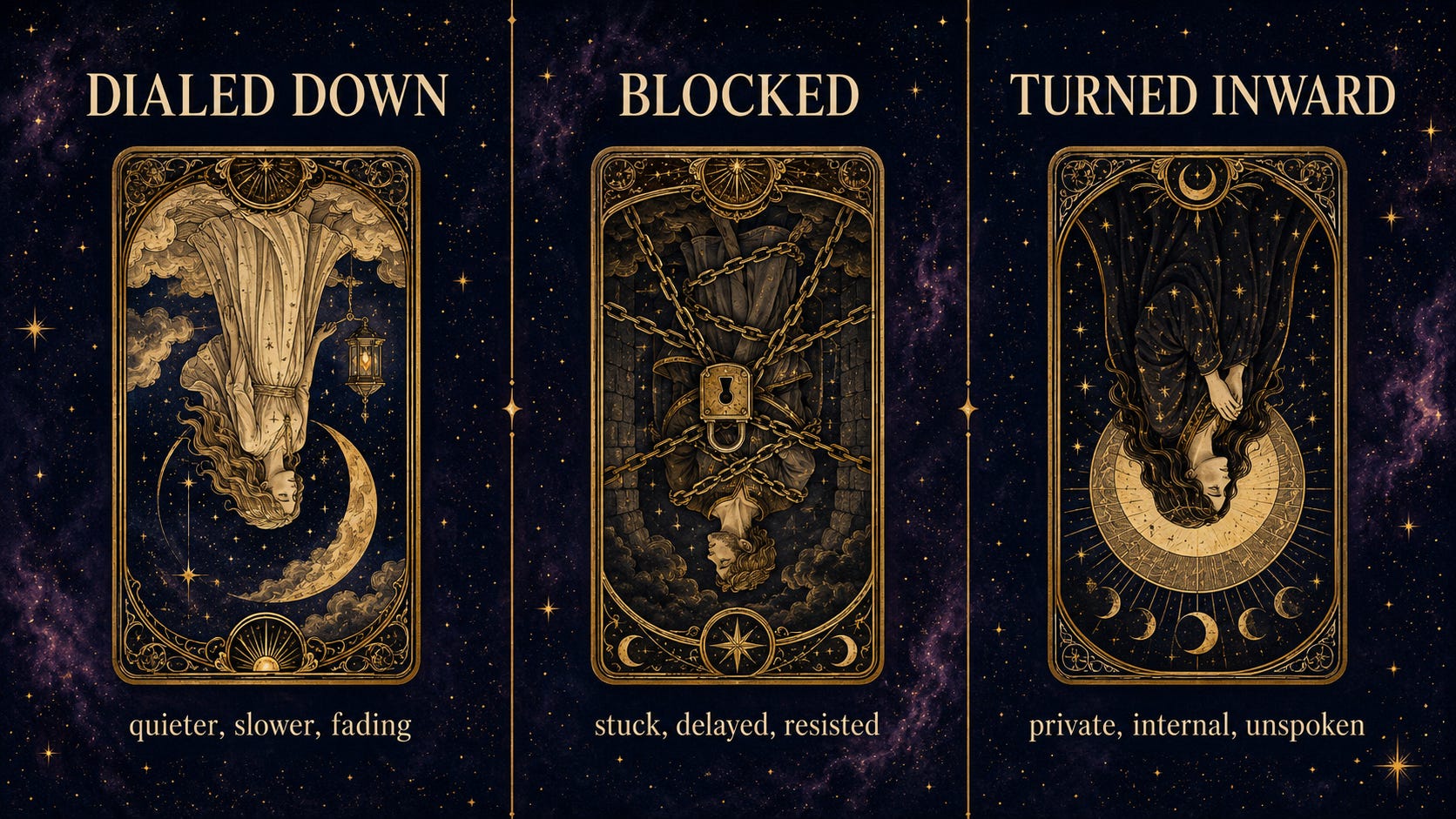
A reversed card is not a different card. It is the same card, with the volume turned down, the flow blocked, or the energy turned inward.
The meaning does not flip. What changes is how loudly, how freely, and in which direction that meaning is moving. You already know the card. You are not learning seventy-eight new ones.
The three doors
When a card lands reversed, you do not need a memorised keyword. You need to ask which of three things is happening. Almost every reversal is one of them.
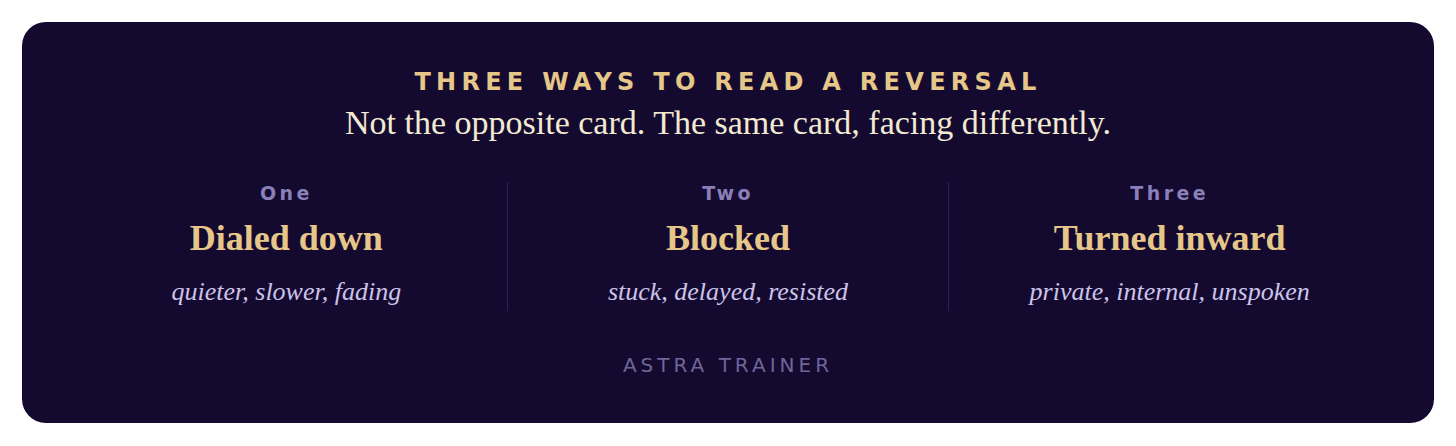
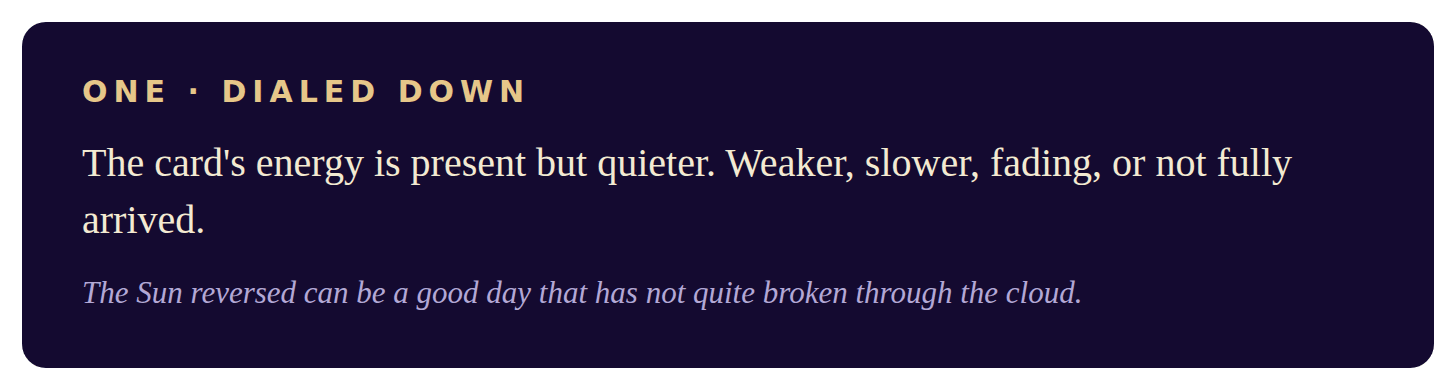
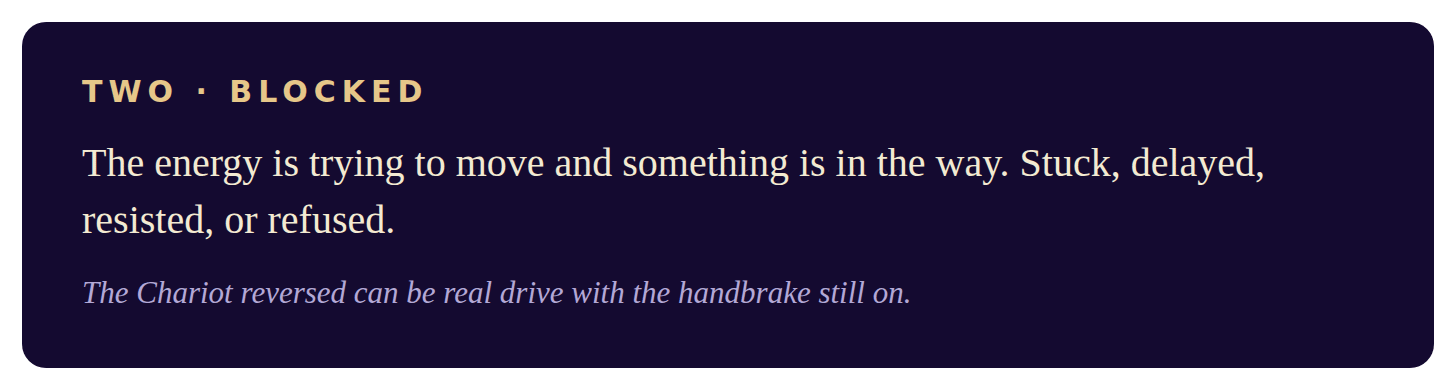
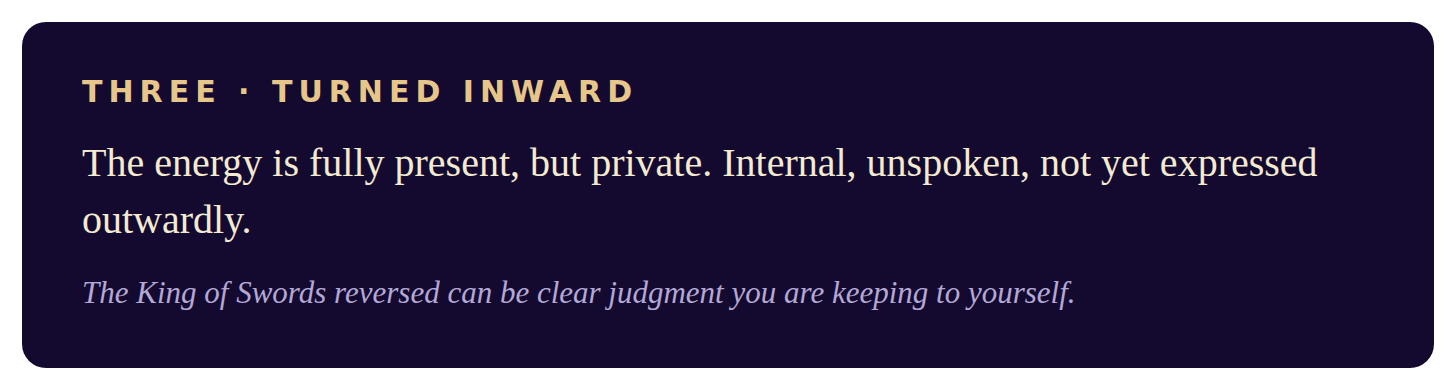
Three doors. When a reversal lands, try them in order. Is this dialed down, blocked, or turned inward? One of them will click.
That is the whole method.
The faster gut check: whispering, or pointing at me?
When a reversal lands and you have no idea where to start, ask one question instead of three.
Is this card whispering, or is it pointing at me?
Whispering means the card’s normal meaning is just softer, slower, or still forming. That is the dialed down or blocked reading. Same story, told at low volume.
Pointing at me means the card has turned to face you. The energy is yours, internal, and probably something you have not said aloud yet.
Most readers find this question answers itself in about a second, which is exactly what you need in the middle of a reading.
A worked example
Say the Eight of Pentacles lands reversed. Upright it is steady, patient craft. The daily reps.
If it whispers, the steady effort has faded. The practice has gone quiet. The fix is small and obvious: restart the reps, tiny.
If it points at you, the work is happening entirely in your head. Planning, researching, worrying, refining the plan again. None of it has become real yet.
Same reversed card, two clean readings, and you never once needed a memorised reversed meaning. You read the card you already knew, then asked which direction it was facing.
Five reversals people look up most
Here are the ones that send people to Google, run through the three doors. Notice that none of them becomes its own opposite.
Death reversed
Upright: an ending, and the transformation on the other side of it.
Dialed down a change that is happening, just slowly.
Blocked an ending you are refusing, so nothing new can start.
Turned inward a transformation happening privately, before anyone else can see it.
The Tower reversed
Upright: sudden collapse, the structure coming down.
Dialed down a smaller disruption, or the near miss you walked away from.
Blocked the collapse postponed, with the pressure still building behind it.
Turned inward an upheaval happening inside you that nobody around you has noticed.
The Lovers reversed
Upright: union, alignment of values, a real choice.
Dialed down a connection cooling rather than breaking.
Blocked a decision you keep declining to make.
Turned inward working out what you actually value before involving anybody else.
Three of Swords reversed
Upright: heartbreak, the clean painful cut.
Dialed down the pain easing, further from the wound than you were.
Blocked grief you have not let move, held rather than felt.
Turned inward hurt you have not spoken to anyone, carried quietly.
The Sun reversed
Upright: clarity, warmth, visible good.
Dialed down the joy is there and muted, a good day under cloud.
Blocked something specific is standing between you and it.
Turned inward quiet private happiness you are not announcing.
Three readings each, none of them the opposite of the card, and all of them arrived at without memorising anything.
Should you use reversals at all?
This gets asked constantly and rarely answered honestly, so: no, you do not have to.
Plenty of excellent readers work entirely upright and simply turn any reversed card the right way up as they deal. Nothing is lost. A 78-card deck read upright is a complete system and always has been.
What reversals give you is resolution. They let one card say this, but quietly or this, but stuck, which is often closer to how a real situation feels. That is worth having, and it is worth having only once the upright meanings are comfortable.
If you are still building those, start with Learn Tarot, and the Major Arcana meanings for the twenty-two that carry the most weight. Come back to reversals after.
A gentle note
You are always allowed to read a reversal as simply this card, but pay extra attention here.
If the three doors ever feel like too much mid-reading, that one sentence is a complete method on its own. Reversals are a nuance, not a test you can fail.
Practise it until it is automatic
Astra Trainer teaches the cards in short daily lessons, upright and reversed, until the three doors stop being a method you remember and start being something you just do. Free to start.
» Start free and open your Tarot world
Frequently asked questions
Does a reversed card mean the opposite?
No, and this is the belief that causes most of the trouble. It means the same card expressed differently: quieter, obstructed, or turned inward.
How do I know which of the three doors applies?
Try them in order and see which one fits the question you asked. If you want it faster, ask whether the card is whispering or pointing at you.
Are reversed cards bad news?
No. A reversed card can be relief, privacy, a slowing down, or a difficult thing losing its grip. Some reversals are the kindest card in the spread.
Should beginners read reversals?
Learn the upright meanings first. Reversals add resolution to a picture you can already see, and they add confusion to one you cannot.
How do reversals get into the deck in the first place?
Shuffling. Some readers rotate half the deck deliberately so reversals occur; others let them arrive naturally through overhand shuffling and cutting. Either is fine, as long as you are consistent.
So tell me, and be honest: when a reversal lands, which door do you reach for first? Dialed down, blocked, turned inward, or do you still freeze?
Freezing is a perfectly respectable answer. Saying it out loud is most of the cure.
Alex, Founder, Astra Trainer 🌟
Reversed meanings for every card in the deck are on the Astra Trainer card reference, one page per card.
Reversals get a section of their own in the Tarot course inside Astra Trainer, with drills rather than lists.