


You don’t need to be psychic or gifted to read tarot — it’s a skill, built from a few simple ideas and a little daily practice. This page is the front door to everything you need, arranged so each guide builds on the last. Bookmark it and work through in order, or jump to whatever you need.
What is actually in a tarot deck
Seventy-eight cards, in two very unequal halves. Almost every confusion a beginner has comes from not knowing which half they are looking at.
The 22 Major Arcana
The headline cards, numbered 0 to 21, from The Fool to The World. These are the big themes: endings, upheaval, love, judgement, luck. When one turns up it is usually pointing at something structural rather than a passing mood, and two or three together mean the situation is a genuine turning point. Full meanings for all 22 are here.
The 56 Minor Arcana
Everything else, and it is where most of a reading actually happens. The Minors handle the texture of an ordinary week: the conversation, the money, the argument, the small decision. They split into four suits of fourteen cards each.
The four suits, and the elements they run on
Cups are water. Emotion, relationships, intuition. They ask how something feels and who is involved.
Pentacles are earth. Money, work, the body, anything you can physically hold. They ask what it costs and whether it is solid.
Swords are air. Thought, truth, conflict, communication. They ask what is actually true, which is not always comfortable.
Wands are fire. Drive, momentum, creativity, ambition. They ask what you want badly enough to chase.
That is the whole system. A card about a difficult conversation is a Sword. A card about rent is a Pentacle. You can place most cards in the right suit before you know a single meaning, just from the question they answer.
The numbers, Ace to Ten
This is the shortcut nobody tells beginners, and it is the single most useful thing on this page. Every suit runs the same shape:
Ace is the seed. Two is the pair. Three is the group. Four is the pause, usually the stall. Five is the loss. Six is the past. Seven is the choice. Eight is the departure. Nine is the arrival. Ten is the whole thing, finished.
Learn that once and you have a working guess at forty cards. A Five is a loss in whatever the suit governs: a Five of Cups is grief, a Five of Pentacles is money trouble, a Five of Swords is a fight you won badly. Same shape, different weather.
The 16 court cards
Four per suit: Page, Knight, Queen, King. They behave differently from the numbered cards because they are usually people, or the part of you that is behaving like one. They trip up more beginners than anything else in the deck. All sixteen, explained.
Your first reading, in three cards
You do not need a spread with ten positions and a diagram. Three cards will do almost everything for the first year.
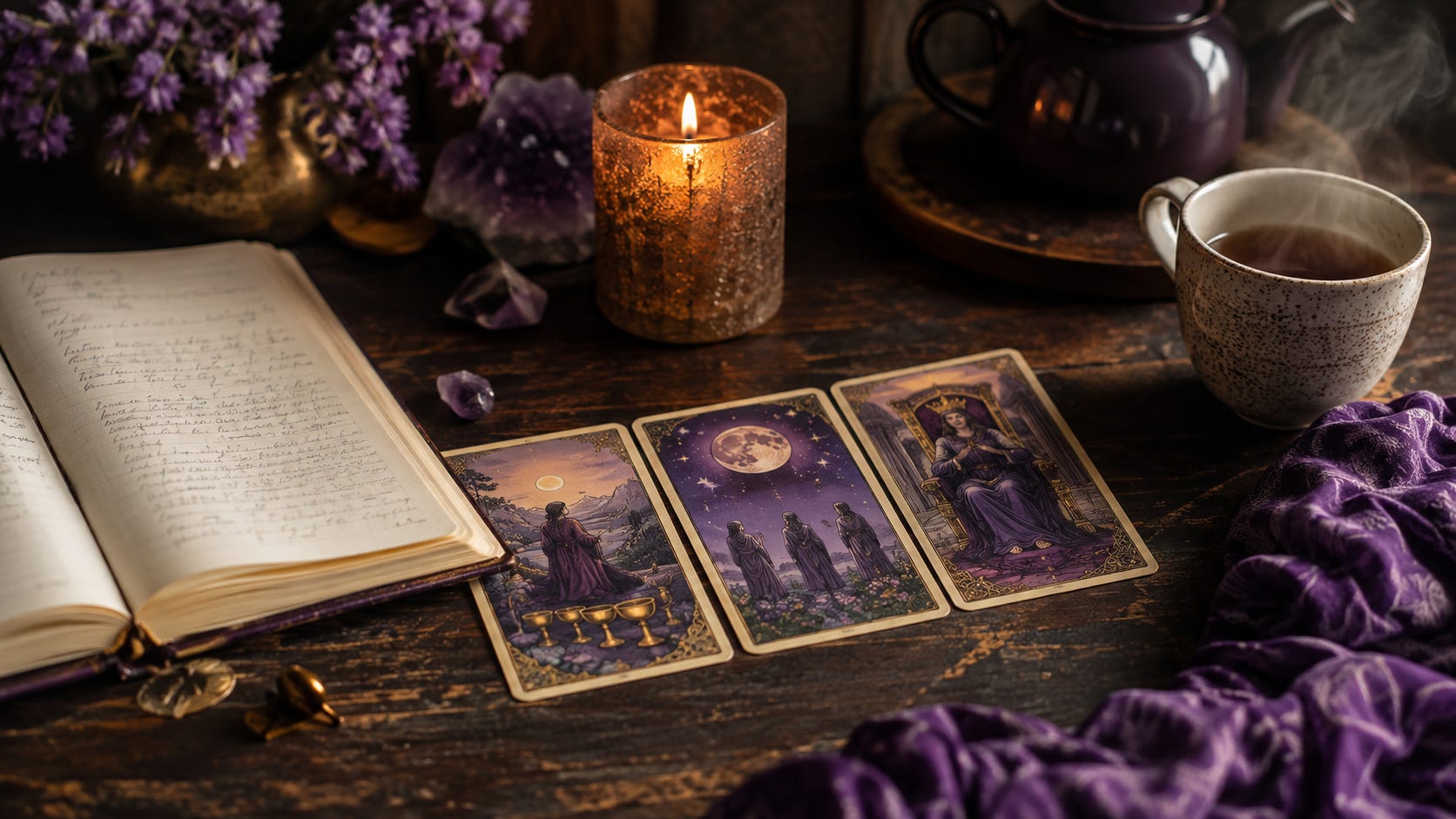
Lay three in a row and give them jobs before you turn them over. The most useful set is not past, present and future. It is the situation, what is acting on it, and where it is heading if nothing changes. That last framing matters, because it makes the reading something you can respond to rather than a prediction you have to accept.
Then, before you look anything up, say out loud what you can see. Colours, postures, weather, whether the figure is facing towards something or away from it.
Describe the picture before you define the card. The definition sticks better when it arrives second.
Only after that should you reach for meanings. And when two cards seem to argue with each other, that is not you getting it wrong, that is the reading. Elemental dignities is the set of rules for what happens when a Sword lands next to a Cup.
Start here — the basics
How to Read Tarot Cards: A Beginner’s Guide
If you’ve never held a deck, begin here. What’s in the 78 cards, the four suits, how to ask a good question, and your first spreads — the whole foundation, no jargon.
Learn the card meanings
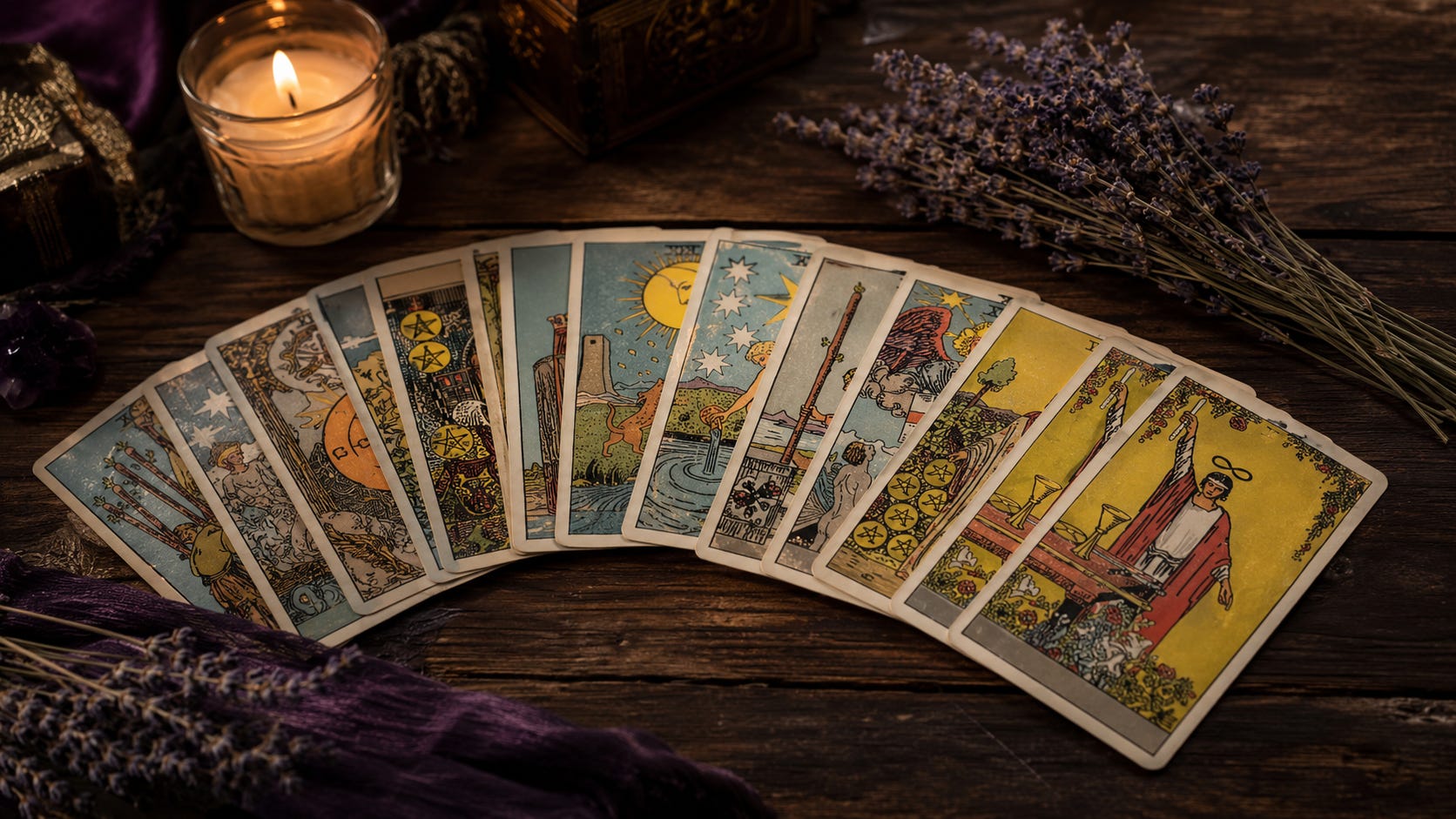
Major Arcana Meanings: All 22 Tarot Cards Explained
The 22 headline cards, from The Fool to The World — each with its upright and reversed meaning. The big, archetypal turning points of a reading.
Tarot Court Cards, Fully Explained
The Pages, Knights, Queens, and Kings — the “people” cards that so often trip up beginners. Who they are and how to read them.
Suit of Cups Meanings: All 10 Cards
Water, feeling, relationships. Ace through Ten, upright and reversed, with what each card means when it actually lands in front of somebody. Pentacles, Swords and Wands follow, and we will link them here as they publish.
Go deeper — reading techniques
Elemental Dignities: How the Cards Talk to Each Other
A reading isn’t separate cards — it’s a conversation. Elemental dignities are the oldest technique for hearing how each card strengthens, weakens, or shifts its neighbours.
Reversed Tarot Cards: How to Read Them Without Freezing
An upside-down card is not the opposite card. Three doors, one fast gut check, and worked examples for the five reversals people look up most.
Runes for Beginners: The Elder Futhark, Explained
Not tarot, but the nearest cousin to it. Twenty-four symbols, no suits and no court cards, and answers that tend to arrive faster than a spread.
Your first month — a simple path
Week 1 — Get comfortable. Read How to Read Tarot Cards and pull one card a day, naming what you see and feel before you look anything up.
Week 2 — Learn the headlines. Work through the Major Arcana, a few cards at a time.
Week 3 — Meet the people. Add the court cards — the ones most beginners find hardest.
Week 4 — Read them together. Try three-card spreads and use elemental dignities to read the cards as one story.
Practice every day
Astra Trainer turns all of this into short daily lessons — card-by-card drills and combination training that teach you to read cards together, ten minutes a day. It’s the fastest way to make everything on this page stick.
» Start free — pick your Tarot world and begin
Frequently asked questions
Where should I start learning tarot?
With the deck itself — read How to Read Tarot Cards first, then learn card meanings a handful at a time. Don’t try to memorise all 78 at once.
How long does it take to learn tarot?
You can pull a meaningful three-card spread within a couple of weeks. Real fluency — reading combinations on sight — comes over a few months of regular practice. Every reading is practice.
Do you have to be psychic to read tarot?
No. Tarot is a skill built on pattern, symbol, and practice. Intuition helps, but it grows with reps like anything else.
Which tarot deck should I start with?
Anything rooted in the Rider-Waite-Smith system with fully illustrated scenes on all 78 cards, so every book and lesson you meet lines up with the deck in your hands. Beyond that, pick the one you actually enjoy looking at, because you will pull from it daily. We went into what makes a good starter deck here.
What is the difference between the Major and Minor Arcana?
The 22 Majors mark turning points and big life themes. The 56 Minors handle the texture of ordinary days, split across four suits. A spread full of Majors is telling you the situation is bigger than you have been treating it.
Should beginners read reversed cards?
Only when you are ready. Plenty of good readers ignore reversals for the first year and lose nothing. When you do start, a reversal almost never means the opposite of the upright card, it means the same energy dialled down, blocked, or turned inward. The three doors are here.
Can I read tarot for myself?
Yes, and most people mainly do. The hard part is not accuracy, it is honesty: it is very easy to keep pulling cards until you get the answer you wanted. One pull, one question, and write it down before you interpret it.
— Alex, Founder, Astra Trainer 🌟
The main site carries the reference version of this roadmap. How to read tarot is where it starts.
If you would rather be taught in order than look things up, the Tarot course inside Astra Trainer walks the whole deck in short daily lessons.