


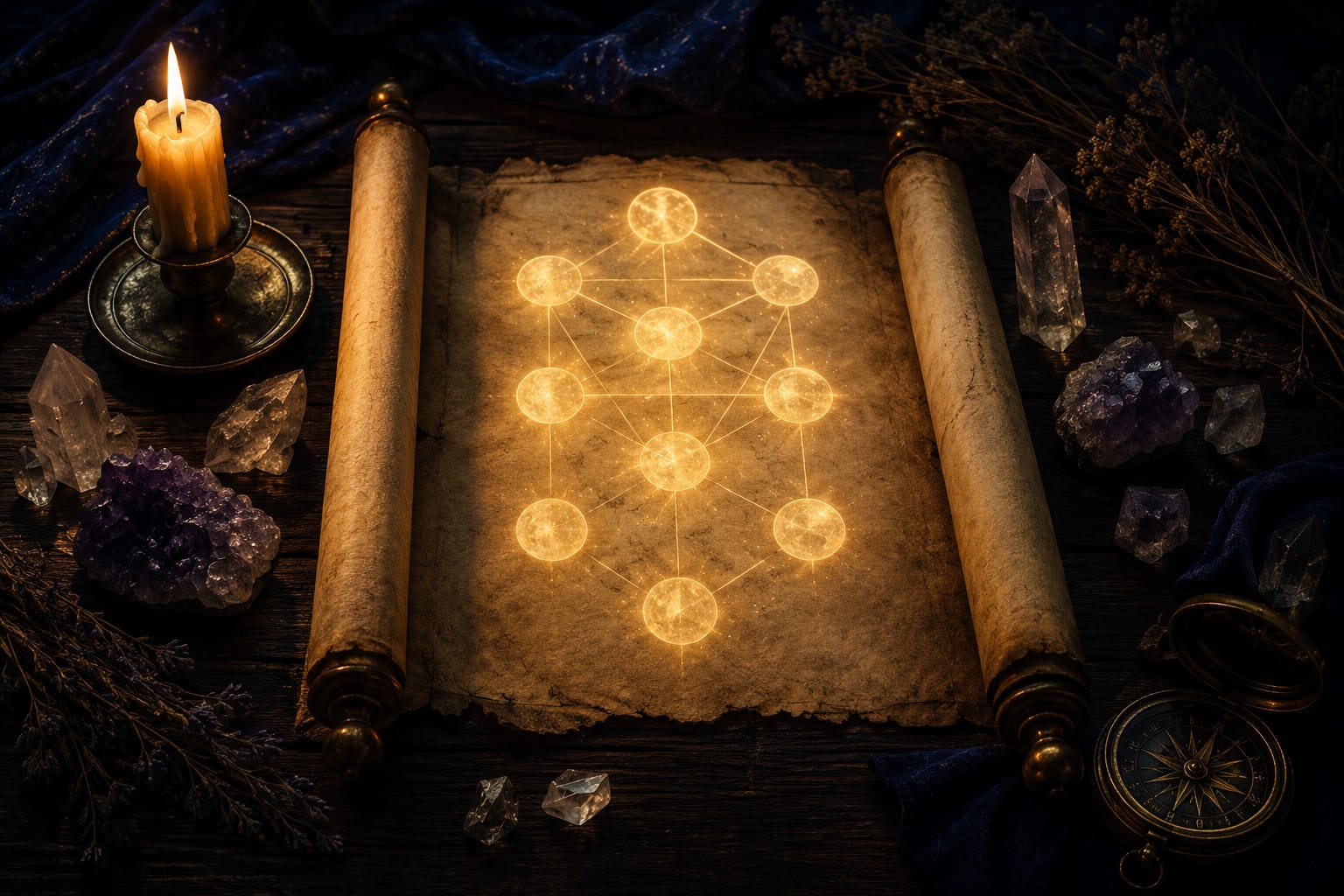
Kabbalah has a reputation for being impossibly deep: centuries of mysticism, Hebrew letters, diagrams that look like circuit boards. Underneath all of it sits one very simple idea, which is that everything from the infinite down to the physical world is connected, and the connections have a shape you can learn.
Here is that shape in plain English: the ten spheres, the three pillars, the four worlds, the twenty-two paths, and an honest account of which parts are ancient and which parts are Victorian.
What Kabbalah actually is
Kabbalah is the mystical tradition inside Judaism. The word itself means "receiving," from the Hebrew root for reception or tradition, which tells you something about the temperament of the thing: it is knowledge handed down rather than knowledge invented.
Its central claim is that the world you can see is the bottom floor of a much taller building, and that the structure of the upper floors is knowable. Not fully. Not quickly. But knowable, in outline, if you have the map.
One note on spelling before we go further, because it confuses everyone. You will see Kabbalah, Cabala and Qabalah, and the usual convention is that they mark three different traditions rather than three ways of typing the same word. Kabbalah is the Jewish tradition. Cabala is the Christian adaptation that grew out of the Renaissance. Qabalah is the Hermetic or occult version, the one that ended up entangled with tarot and ceremonial magic. They share a diagram and a vocabulary, and they are not the same subject. Most of what follows is the shared core, and where the Hermetic layer starts, this piece will say so.
The Tree of Life
The central image of Kabbalah is the Tree of Life, in Hebrew Etz Chaim. It is a diagram of ten spheres connected by twenty-two paths. Read downward it maps how the infinite pours into the world we live in. Read upward it maps the human soul and the journey back toward the source. Same tree, two directions, and which way you are reading it changes what every sphere means.
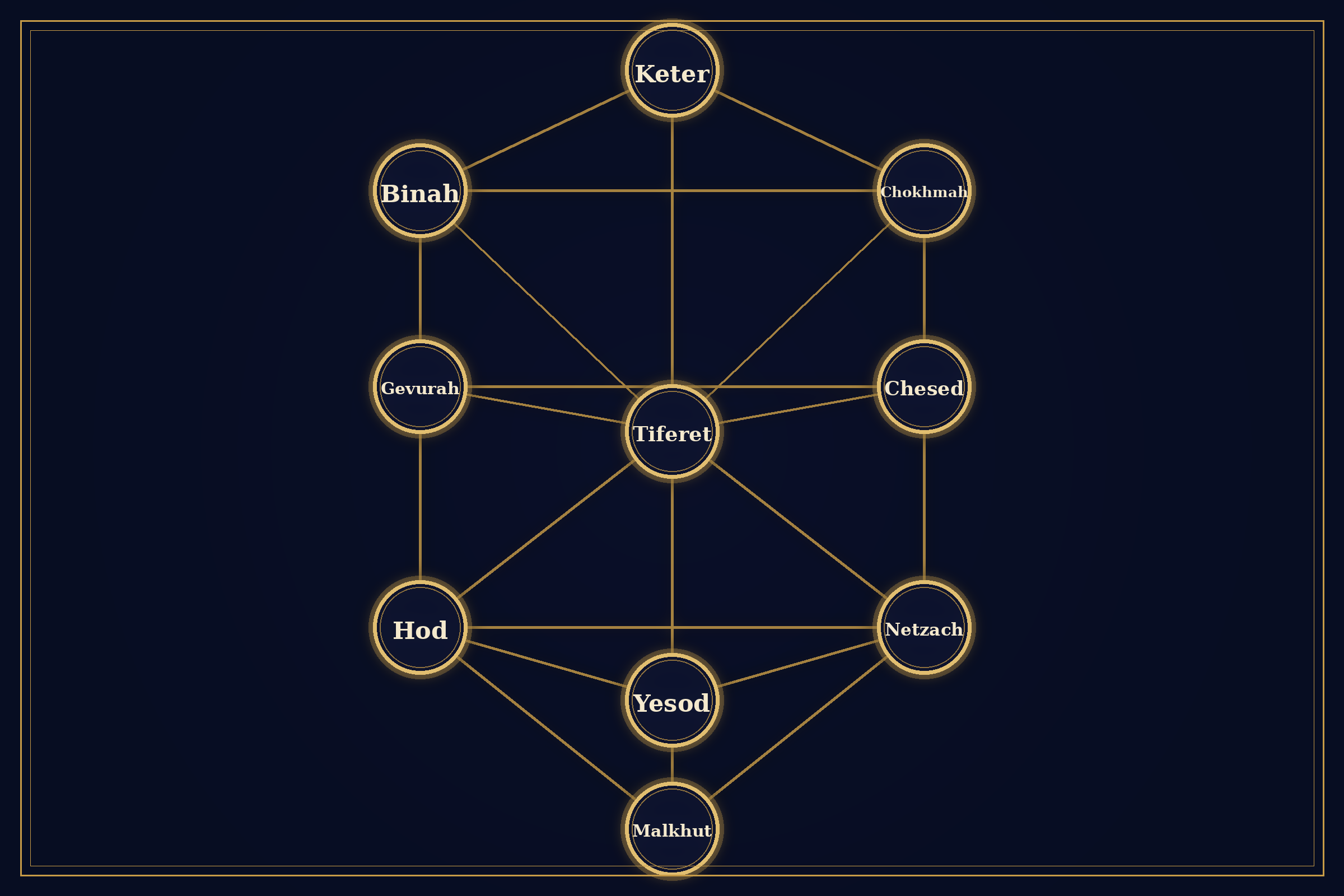
Above the whole tree sits Ein Sof, "the infinite," the unknowable source with no image and no name. Everything below is the account of how that infinity becomes something a person can actually experience.
The ten sephirot
The ten spheres are the sephirot (singular sephirah). Think of them as ten qualities of divine energy, arranged in the order in which reality unfolds, from pure undifferentiated will at the top to the physical world at the bottom.
1. Keter, the Crown. Pure will, before it has decided anything. The first spark, so close to the infinite that most schools treat it as barely knowable.
2. Chokhmah, Wisdom. The flash of insight that arrives whole and wordless. It is not thinking. It is the thing that happens a half second before thinking.
3. Binah, Understanding. That flash given shape, structure and boundary. Where Chokhmah is the lightning, Binah is the vessel that catches it and makes it usable.
4. Chesed, Loving-kindness. Boundless giving. Expansion with no brakes. Wonderful in principle, and on its own it produces a person who cannot say no to anything.
5. Gevurah, Strength. Discipline, limit, judgment. The brakes. On its own it produces someone rigid and cold, which is the point: neither sphere works alone.
6. Tiferet, Beauty. The balanced heart of the tree, where mercy and severity meet and become something liveable. Most of the tree's traffic passes through here.
7. Netzach, Eternity. Drive, endurance, the force that keeps going after the enthusiasm has worn off. Victory in the sense of persistence rather than triumph.
8. Hod, Splendour. Intellect, language, form. The part that names things and builds systems out of them.
9. Yesod, Foundation. Where everything above gathers and is stored before it becomes real. The imagination, the subconscious, the staging area.
10. Malkuth, Kingdom. The physical world. Here. Now. This chair. Everything above only matters because it arrives somewhere.
Learn these ten names and their one-word meanings first. Everything else in Kabbalah hangs off them, and nothing else makes sense until they are solid.
The three pillars
Look at the tree and the sephirot fall into three columns, called pillars.
The right pillar, Mercy. Expansion, giving, force. Chokhmah, Chesed, Netzach.
The left pillar, Severity. Restraint, structure, limit. Binah, Gevurah, Hod.
The middle pillar, Balance. Where the two are reconciled, running straight down the centre from Keter through Tiferet and Yesod to Malkuth.
The whole system turns on that balance. Too much mercy with no limits, or too much severity with no warmth, and the thing collapses. The middle pillar is the path of equilibrium, and it is also the route most contemplative practice actually walks.
The four worlds
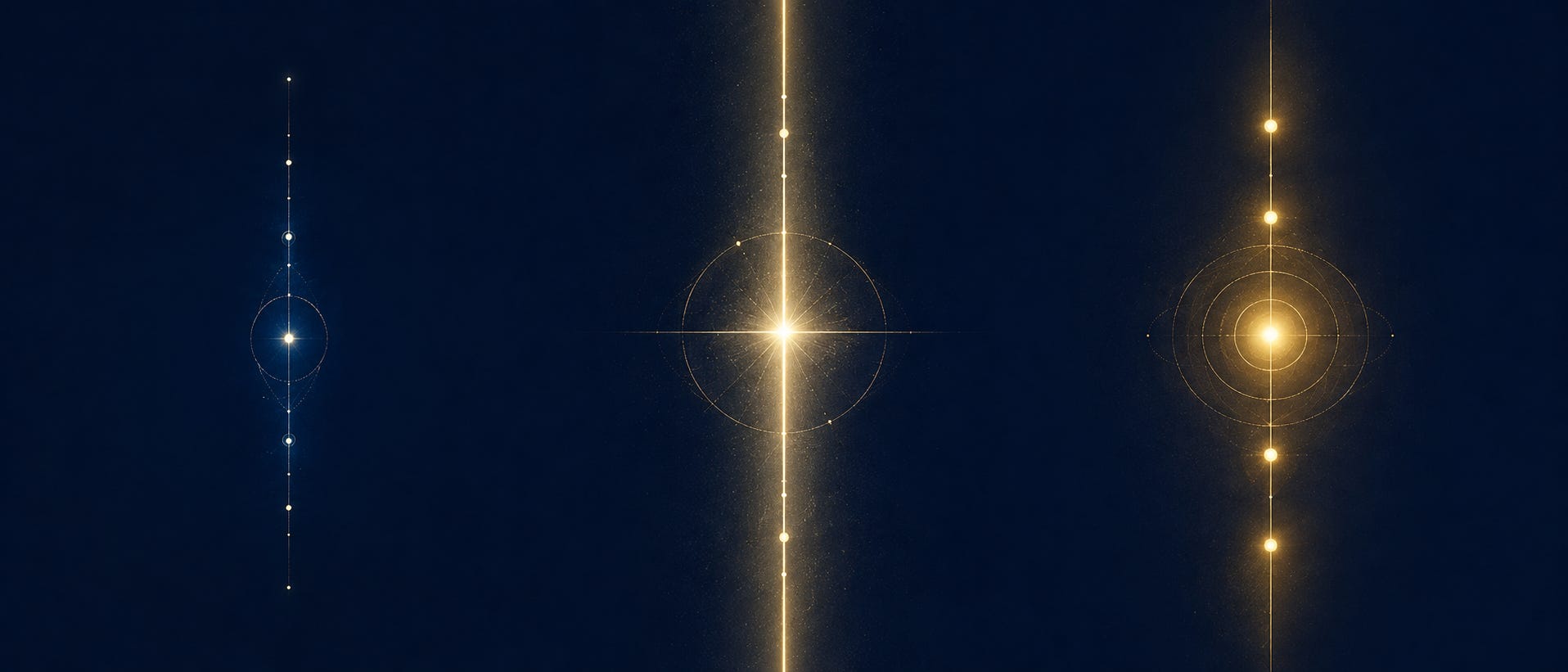
The tree is also read as four stacked realms, each a stage in how something moves from idea to thing. In descending order they are Atziluth (emanation), Beriah (creation), Yetzirah (formation) and Assiah (action).
The everyday version is not mystical at all. An impulse arrives, it takes conceptual shape, it acquires a specific form, and then somebody actually does it. Anyone who has had an idea in the shower and shipped it eight months later has travelled all four.
The twenty-two paths
The lines connecting the sephirot are the twenty-two paths, and they correspond to the twenty-two letters of the Hebrew alphabet. Ten spheres plus twenty-two paths give the thirty-two "paths of wisdom" named in the Sefer Yetzirah, which is why the paths are conventionally numbered 11 to 32.
In the Hermetic tradition, each path also carries one card of the tarot's Major Arcana. This is the join between two systems that most people meet Kabbalah through, so here it is in full:
Aleph · The Fool | Beth · The Magician | Gimel · The High Priestess
Daleth · The Empress | Heh · The Emperor | Vav · The Hierophant
Zayin · The Lovers | Cheth · The Chariot | Teth · Strength
Yod · The Hermit | Kaph · Wheel of Fortune | Lamed · Justice
Mem · The Hanged Man | Nun · Death | Samekh · Temperance
Ayin · The Devil | Peh · The Tower | Tzaddi · The Star
Qoph · The Moon | Resh · The Sun | Shin · Judgement
Tav · The World
Read that list next to the twenty-two Major Arcana and the whole sequence stops being a random parade of images. The Fool is the first letter and the first breath. The World is the last letter and the completed circuit. Everything between them is a route from one sphere to another.
Two honest caveats, because this is where guides tend to bluff.
Published trees disagree about the middle. The letter-to-card assignments above are stable across sources. Which two sephirot a given path connects is less stable, and reputable diagrams contradict each other in the crowded centre of the tree. Use whichever tree your teacher or your deck uses, and do not assume a different diagram is an error.
Crowley moved two of them. The Thoth deck swaps The Emperor and The Star, on the strength of a line in Liber AL vel Legis saying that Tzaddi is not the Star. In Crowley's arrangement The Emperor takes Tzaddi and The Star takes Heh. If you work with a Thoth deck, your correspondences will differ from the list above at exactly those two cards.
Where the tarot connection actually comes from
Worth stating plainly, since almost nobody does. The mapping of tarot onto the Tree of Life is not ancient, and it is not part of traditional Jewish Kabbalah. It is a Western esoteric development of the nineteenth century, formalised by the Hermetic Order of the Golden Dawn, which read Jewish source material as universal ancient wisdom and merged it with astrology, ceremonial magic and the tarot deck.
That does not make it worthless. It is a coherent, deeply worked-out system, and if you read tarot it will change how you see the deck. It does mean that a rabbi studying Kabbalah and a tarot reader studying Qabalah are, past a certain point, studying two different things that share a diagram. Knowing which one you are doing is not pedantry. It is the difference between understanding a tradition and repeating a rumour about it.
How to start
You do not climb the whole tree on day one. A workable order:
Learn the ten sephirot. A name and a one-word meaning for each. This is the only part you must memorise.
See the three pillars. Once you can look at any sephirah and say which column it is in, the logic of the diagram opens up.
Walk the middle pillar. Malkuth to Yesod to Tiferet to Keter. It is the shortest honest route up, and it is the one most contemplative practice uses.
Only then, the paths. Twenty-two more items is a lot. They will make sense once the spheres are automatic, and they will be noise before that.
Sit with one sephirah at a time and ask where you meet it in your own life. Where is your Chesed running unchecked. Where is your Gevurah doing all the talking. Where does your Yesod store things you have not looked at. It is a slower kind of study than most systems ask for, and it is the reason people stay with it for decades.
Where Kabbalah sits next to everything else
Kabbalah is the structural one. Tarot gives you images and narrative. Runes give you twenty four blunt, concrete symbols. Numerology gives you a single number to argue with. Astrology gives you timing and temperament. Kabbalah gives you the frame the others can be hung on, which is exactly why it is the hardest one to start with and the most useful one to have finished.
How to practice
Kabbalah rewards slow, repeated study. It is a lifetime map, not a weekend read. Astra Trainer's Kabbalah course walks the Tree of Life one sephirah at a time in short daily lessons, and it sits inside the Esoteric World alongside tarot, astrology, numerology and runes.
» Start free and explore the Tree of Life in the app.
Tag @astra_trainer on Instagram with the sephirah you’re sitting with this week.
Until next time, keep learning, and be kind to yourself on the days it is hard.
— Alex, Founder, Astra Trainer 🌟

The Kabbalistic correspondences run through the whole deck. Every card, upright and reversed, has its own page in the Astra Trainer card reference.