


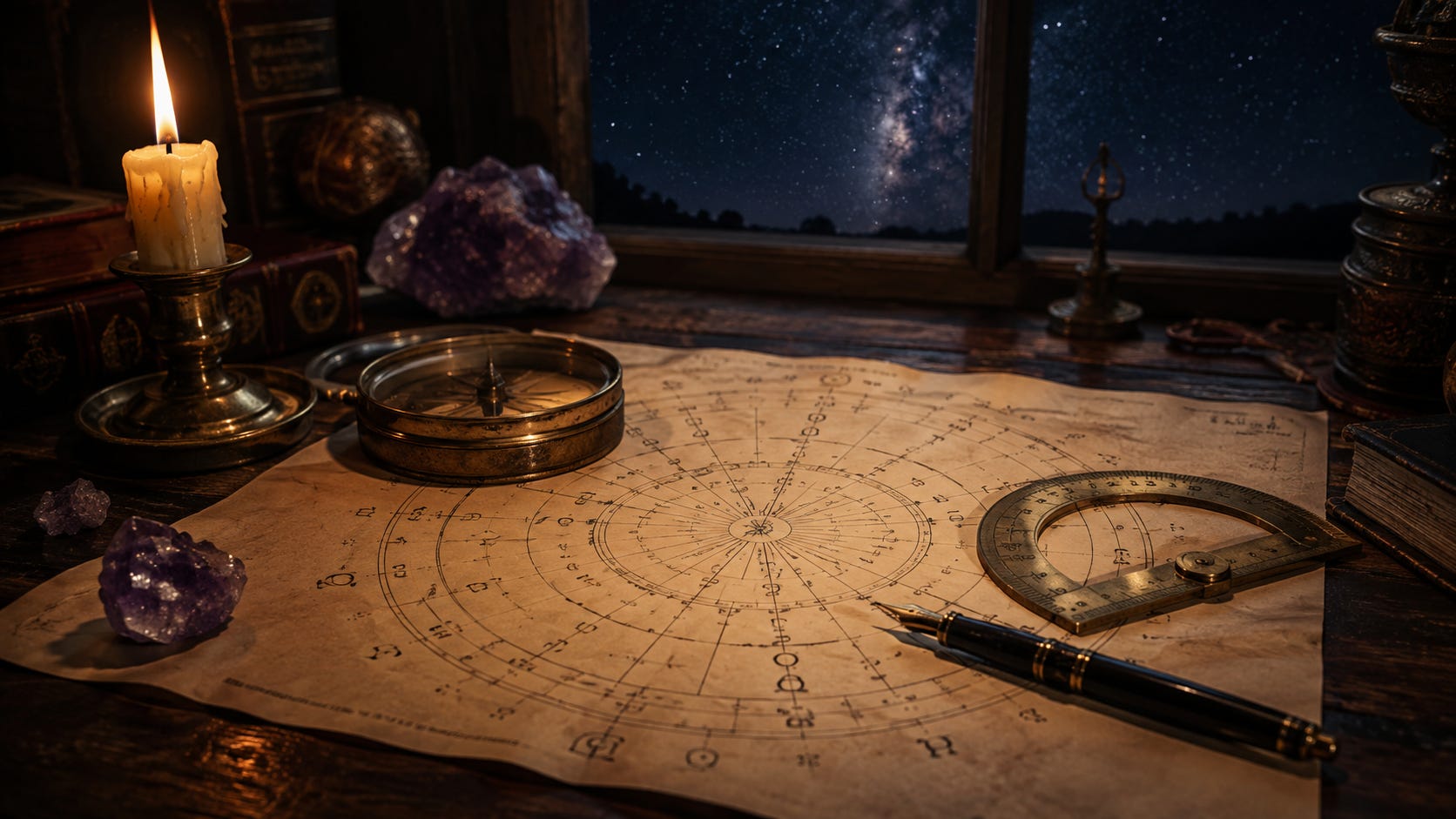
The first time I opened my own birth chart I closed it again inside a minute.
It was a circle cut into twelve slices, filled with symbols I did not know, crossed by a web of coloured lines that clearly meant something to somebody. Around the edge, a ring of glyphs. In the middle, geometry. It looked less like a portrait of me and more like the wiring diagram of a building I was not allowed into.
I knew one thing on that entire page. Sun in Scorpio. Which I could have told you without the chart.
What nobody had said, and what would have saved me about a year, is this: you are not supposed to read the whole thing. Not at once, not ever. A birth chart is not a picture you take in. It is a language, and language comes one sentence at a time.
What a birth chart actually is
A birth chart, or natal chart, is a snapshot of the sky at the exact moment and place you were born. Everything in it is a real position of a real body at a real time. Nothing is invented.
To cast one you need three things: your date of birth, your time of birth, and the place.
The time is the one people skip, and it is the one that matters most. Your Rising sign changes roughly every two hours, and the Rising sign sets the position of all twelve houses. Get the time wrong by three hours and you have not made a small error. You have rotated the entire chart and put every planet in the wrong room.
Birth certificates usually carry it. If yours does not, ask whoever was there, and if nobody knows, work with your Sun and Moon and treat the houses as provisional. That is a real limitation and it is better than a confident wrong answer.
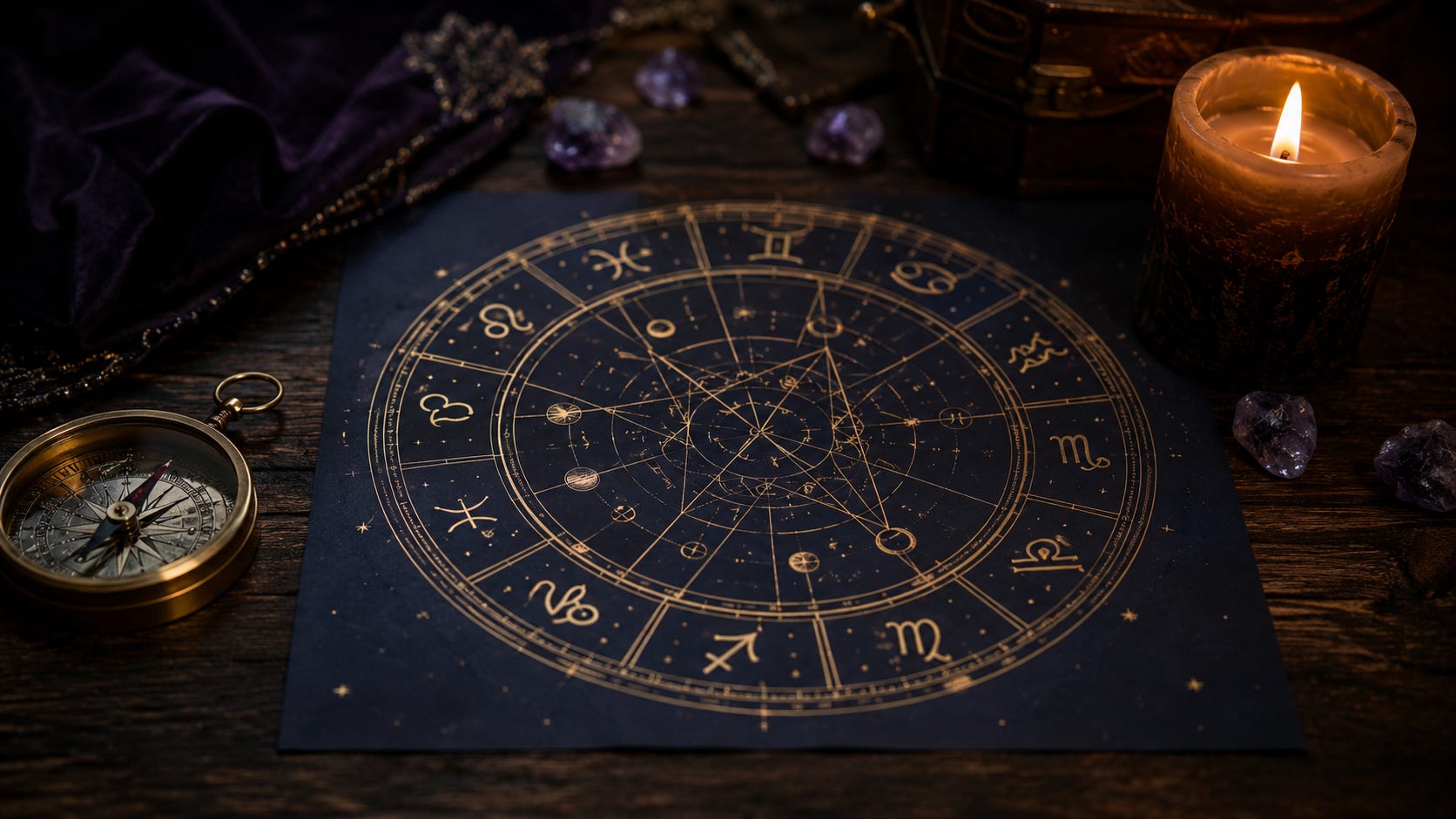
The grammar: three building blocks
Every single placement in your chart is made of the same three parts. Learn them and you have the whole grammar.
Planets are the what. The part of you being described. Your drive, your feelings, your way of thinking.
Signs are the how. The style that part of you runs in. Blunt, careful, restless, guarded.
Houses are the where. The area of life it keeps showing up in. Work, home, money, other people.
That is it. What, how, where. Every line of your chart is those three things stuck together, and every reading you will ever do is that sentence said out loud.
A birth chart looks like a circuit diagram and reads like a sentence.
Start with the Big Three
Three placements carry more weight than the rest, and they are the ones to read first.
Your Sun is your core self, what you are working towards, what lights you up. Your Moon is your emotional world, what you need in order to feel safe, and it is usually the placement that makes people go quiet when they first hear it described. Your Rising, or Ascendant, is what you meet the world with and how strangers read you before you have said anything.
Those three alone explain a surprising amount about a person, which is why they get their own name.
If the signs themselves are still fuzzy, our guide to all twelve zodiac signs covers each one with its dates, element and ruling planet.
Now say them as sentences
Take the placement, and read it in the order what, how, where. Here are two.
Sentence oneMoon (what someone feels) in Scorpio (privately, and all the way down) in the 4th house (at home, with family).
Read it back. That is a person who does not do their feelings in public, and whose family is where the deepest ones live. You did not need a glossary for that. You needed the three words in the right order.
Sentence two Mars (how someone chases things) in Libra (diplomatically, avoiding conflict) in the 10th house (in my career).
Someone ambitious who will not fight for it directly. That is a whole person, out of three words, in ten seconds.
Do this once and the chart stops being a wall. Do it ten times and you are reading.
The rest of the planets
Once the Big Three are comfortable, the others fill in the detail. Each one is another what.
Mercury: how you think, speak and learn.
Venus: how you love, and what you find beautiful.
Mars: your drive, your anger, how you chase what you want.
Jupiter: growth, luck, where life expands on you.
Saturn: limits, discipline, the lesson that takes years.
Uranus, Neptune and Pluto: the slow ones. Change, dreams, transformation.
The last three move so slowly that everyone born within a few years of you shares them. They describe a generation more than a person, so read them last and lightly.
The twelve houses, in plain English
The houses run counterclockwise from your Rising sign, and each one covers an area of life. Whichever house a planet sits in is the part of your life it is busiest with.
1st self and first impressions · 2nd money and self-worth · 3rd communication and siblings
4th home and family · 5th play, romance and creativity · 6th work, routine and health
7th partnership · 8th shared resources and intimacy · 9th belief, travel and study
10th career and reputation · 11th friends and community · 12th the inner world and what is hidden
There is a pattern worth noticing. The first six houses are about you. The second six are about you meeting everyone else. That symmetry is the fastest way to remember the lot.
The lines in the middle, and why to ignore them
Those coloured lines crossing the centre are aspects, the angles between planets. Some flow easily, like trines and sextiles. Some create tension that drives growth, like squares and oppositions.
They matter. They do not matter yet.
Aspects describe how two placements talk to each other, and you cannot hear a conversation between two things you have not met. Read your planets, signs and houses first. The lines will still be there in a month, and they will make sense then in a way they cannot now.
This is the step where most beginners drown, and it is because someone handed them the whole chart at once instead of telling them what to skip.
The order to read it in
One. The Big Three. Sun, Moon, Rising, each as a sentence.
Two. The personal planets by sign. Mercury, Venus, Mars.
Three. The same planets by house. Where each one lives.
Four. The slow planets, lightly.
Five. Aspects, once everything above feels automatic.
Read your own chart first, then the charts of people you know well. Strangers teach you nothing at this stage, because you cannot check yourself. A friend you understand is a marked answer sheet.
Putting two sentences together
Here is where it stops being a vocabulary test and starts being a reading.
Say someone has Moon in Scorpio in the 4th house, the first sentence above. Private feelings, kept at home. Now say they also have Mercury in Sagittarius in the 3rd house: how they think, done bluntly, in everyday conversation.
On their own those are two facts. Put them side by side and you have a tension worth naming. Someone who says exactly what they think about everything, and almost nothing about what they actually feel. Blunt in the pub, sealed shut at the kitchen table.
That is a reading. Not a longer glossary, just two sentences held next to each other until you notice what they say about one another.
You do not need aspects for this. You need two sentences and the patience to look at them together.
Questions people ask first
What if I do not know my birth time?
Read your Sun and Moon and treat the houses and Rising as unknown. Do not guess and then build on the guess. An honest gap is workable, a confident wrong answer is not.
Do I need to pay for a chart?
No. Casting a chart is arithmetic on astronomical data, and plenty of free tools will draw one for you in seconds. What costs you something is learning to read it.
Why does my chart look different on two different sites?
Usually house systems. There is more than one way to divide the wheel into twelve, and different sites default to different methods. Your planets and signs will match. Your house numbers may not. Pick one system and stay with it while you learn.
How long before I can read a chart?
You read your first sentence today. Reading your own chart end to end takes about a month of steady practice. Reading a stranger’s on sight takes years, and everyone doing it now started where you are.
One sentence at a time
That is the thing worth keeping from all of this.
Nobody reads a whole chart at once. Not you, not me, not the person who has been doing it for thirty years. They read one sentence, then the next, then they notice the two sentences are about the same thing, and that noticing is what people call intuition.
You are three words away from your first one.
Working through the whole system in order? Learn Astrology is the beginner roadmap this guide sits inside.
Learn it properly, five minutes a day
Astra Trainer teaches astrology the way you would learn a language. Short daily lessons, planets and signs and houses, until you can read a whole chart without looking anything up. Free to start.
» Start free and open your Astrology world
So here is the only homework. Take one placement from your chart and write it out as a sentence in the comments. Planet, sign, house, in that order.
I will put one of mine down there to start it off. Write yours underneath and I will tell you what I see in it.
Alex, Founder, Astra Trainer 🌟
The reference version, with every placement broken out, is the natal chart guide on the main site.
Reading a chart properly takes repetition more than reading. The Astrology course in the app is built around that.
I love the practice of saying the placements as sentences! That’s a great way for people to understand themselves…
I agree entirely re aspects. The energy is still expressing! The aspects just determine the flow!
🌕🌞