


Last time, in Find Your World, we walked all seven worlds of Astra Trainer and how to choose where to begin. Today we go deep into one of them — the Spiritual world — and the quiet piece of Tarot that turns a pile of memorized cards into a reading that actually flows.
Start here
Here’s a moment every reader knows.
You lay down a spread. You know each card. You can recite the meanings cold — the app made sure of that. And yet the reading feels like a pile of separate sentences that won’t become a paragraph. The cards are all there. They’re just not talking to each other.
Most people blame themselves. I don’t have the gift. I’m not intuitive enough. But that’s almost never the problem. The problem is that you were taught the deck as 78 isolated flashcards — and a real reading is never isolated cards. It’s a conversation between them.
There’s a centuries-old technique that turns that pile of sentences into a paragraph. It’s called Elemental Dignities, and it was being used by readers of the Golden Dawn long before “card meanings” were printed on little booklets. It almost never shows up in beginner books. When it does, it’s usually one confusing paragraph and a shrug.
Once you can hear the cards talking to each other, a spread stops being a list and starts being a story — one that practically reads itself. And it works in ways you’d never guess: two “good” cards can quietly cancel each other out, and two “scary” cards can lock into something clear and strong. The cards decide together — never one at a time.
If you’ve ever felt like you’re translating word-by-word in a language you don’t quite speak yet — this is the grammar nobody handed you.
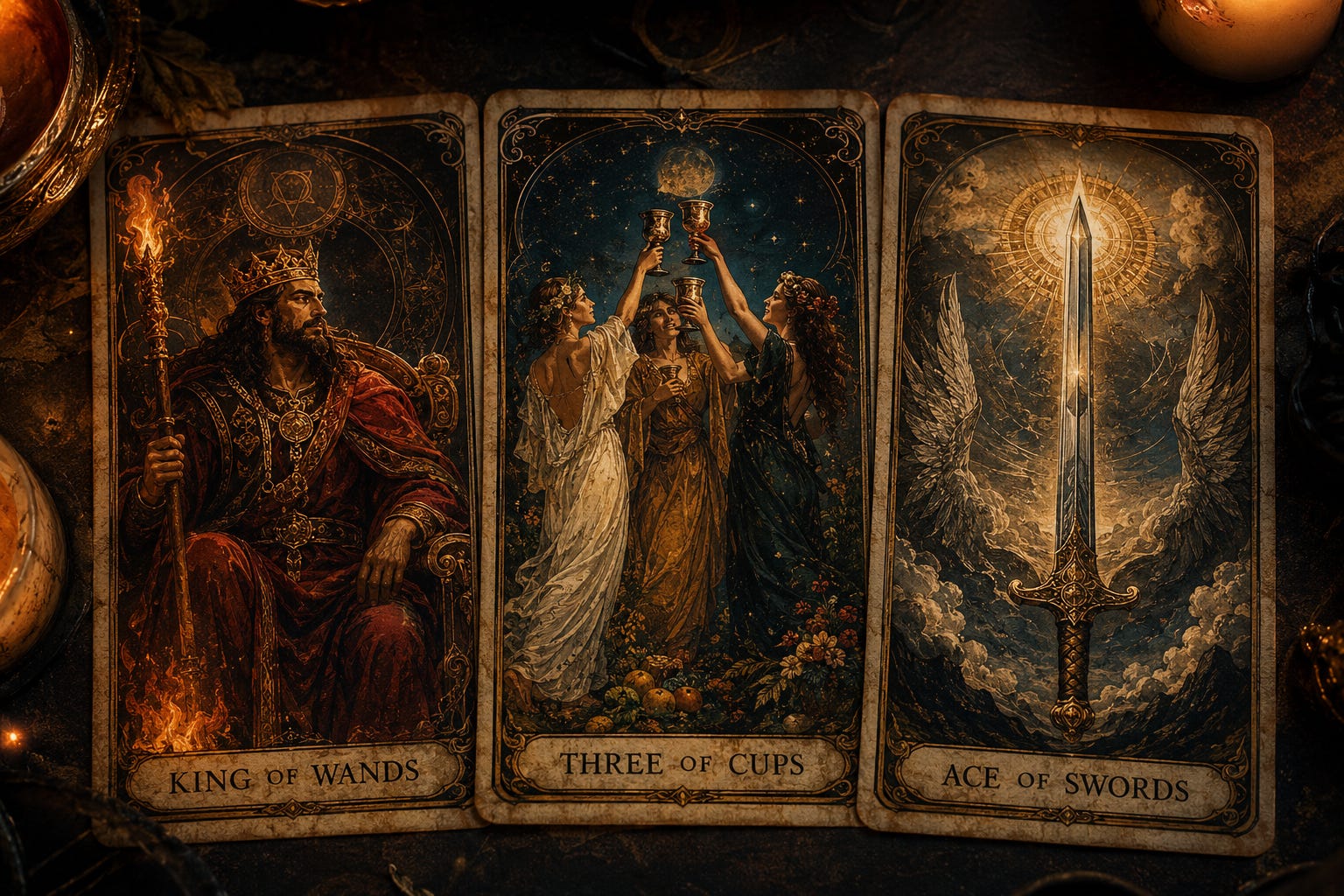
Here’s a taste. Pull these three, left to right: King of Wands · Three of Cups · Ace of Swords.The flashcard read — “a powerful man, a celebration, a bright idea” — is three sentences that don’t add up. But once you can hear the elements, that celebration in the middle isn’t a celebration at all. It’s a warm moment under quiet attack — and the spread tells you exactly who’s draining it, and why.
That reading — and the simple three-rule system that produces it in seconds — is right below. 👇
The full system
It all rests on one idea:
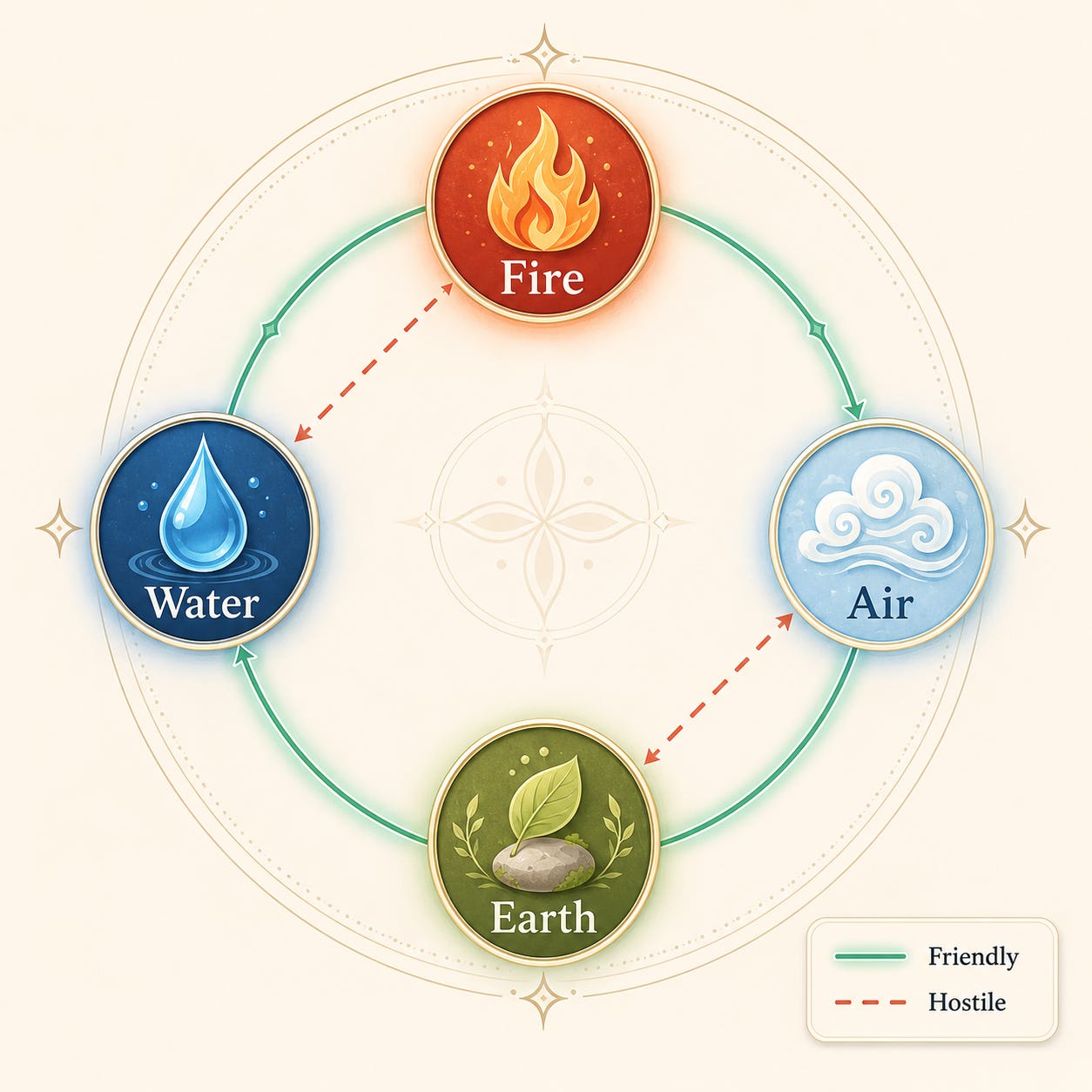
Every card belongs to an element. And elements either strengthen, weaken, or transform their neighbors. A card never means exactly the same thing twice — because it’s always being colored by whatever sits beside it.
That’s the whole secret. Fire (Wands), Water (Cups), Air (Swords), and Earth (Pentacles) each have friends they amplify, enemies they fight with, and neutral partners they quietly shift. Learn the three relationships below and you’ll read any pair on sight — starting with those three cards from up top.
Step 1 — Know which element each card is
You already half-know this. Let’s make it exact.
The four suits (Minor Arcana):
Wands = Fire 🔥 — drive, passion, action, will, conflict, creativity
Cups = Water 💧 — emotion, love, intuition, relationships, the unconscious
Swords = Air 🌬️ — thought, communication, truth, conflict, the mind
Pentacles = Earth 🪙 — body, money, work, home, the material world
The Major Arcana carry elements too, through their astrological and planetary rulers. You don’t need to memorize all 22 at once, but the key ones:
Fire Majors: The Emperor (Aries), Strength (Leo), Temperance (Sagittarius), The Sun, The Wheel of Fortune
Water Majors: The High Priestess (Moon), The Hanged Man, Death (Scorpio), The Moon (Pisces), The Star
Air Majors: The Fool, The Magician (Mercury), The Lovers (Gemini), Justice (Libra)
Earth Majors: The Empress (Venus), The Hierophant (Taurus), The Hermit (Virgo), The Devil (Capricorn), The World (Saturn)
Don’t panic about the Majors yet. For your first month of practice, just read the suit elements. Add Majors once the suits feel automatic.
Step 2 — Learn the three relationships
This is the engine. Memorize these three rules and you have the whole system.
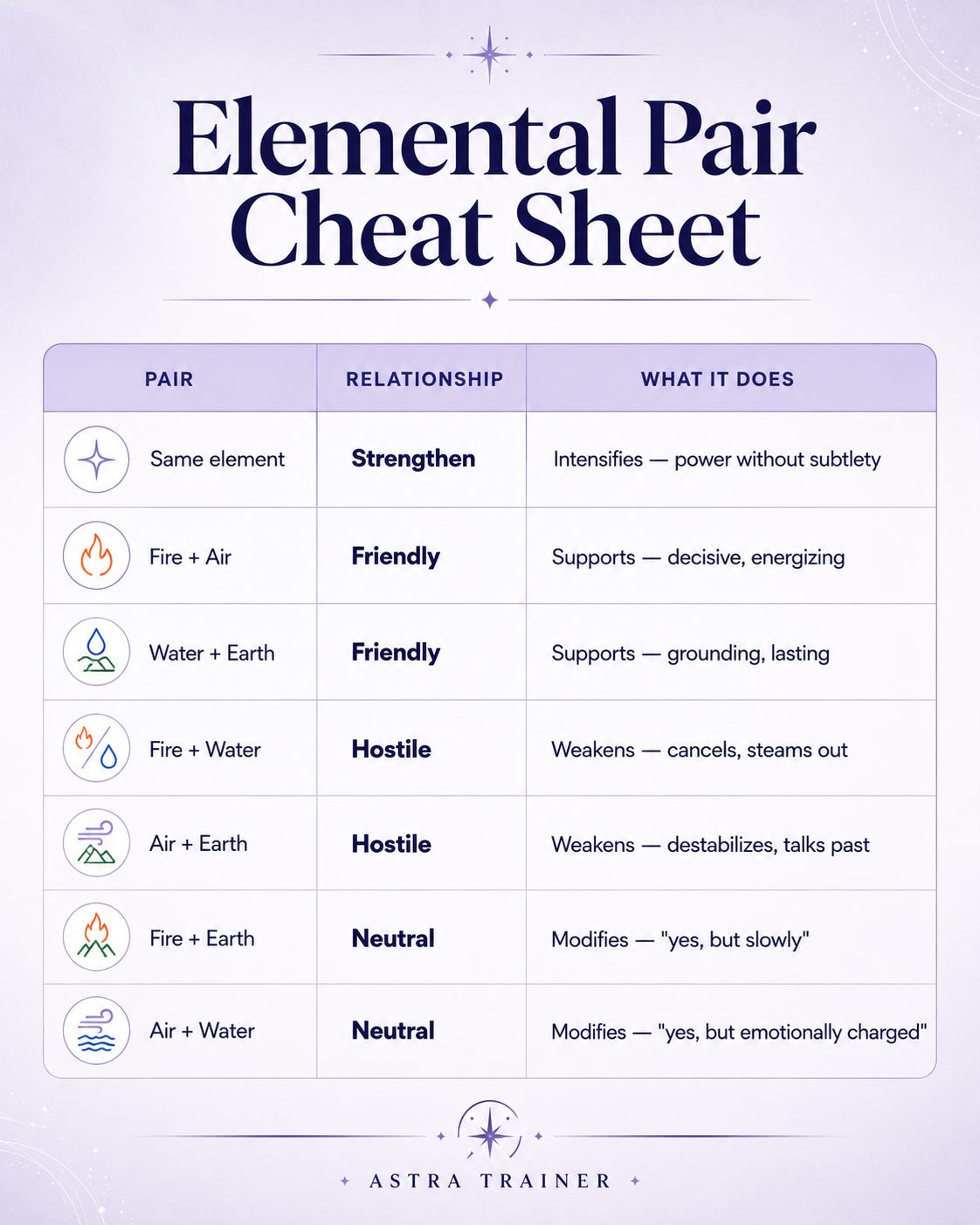
1. Same element = STRENGTHEN (and intensify). Two Fire cards together? The fire roars. Two Water cards? The feeling floods. Same-element pairs amplify each other — for better or worse. Two passionate cards become obsession. Two emotional cards become overwhelm. Power, but rarely subtlety.
2. Friendly elements = STRENGTHEN (and support). Some elements are natural allies:
Fire & Air are friends 🔥🌬️ — air feeds fire. Will + thought = decisive action.
Water & Earth are friends 💧🪙 — water nourishes earth. Emotion + stability = things that last.
Friendly pairs help each other along. The reading flows. Energy moves forward.
3. Hostile elements = WEAKEN (and destabilize).
Fire & Water are enemies 🔥💧 — they cancel. Steam, hiss, nothing left. Passion drowned, or feelings burned away.
Air & Earth are enemies 🌬️🪙 — thought uproots stability; the practical and the abstract talk past each other.
When hostile elements sit together, both cards lose force. The energy stalls. Something is being undermined.
4. Neutral pairs = MODIFY. Fire & Earth, Air & Water are neutral — neither friends nor enemies. They don’t strengthen or weaken so much as flavor each other. Read them as “yes, but…” — one card adds a condition to the other.
Here’s the cheat-sheet to screenshot:
Step 3 — Read three cards as a sentence
The classic dignity reading uses three cards in a row, and here’s the trick almost no booklet explains:
The center card is the message. The two outer cards are modifiers — they tell you whether the center is strong, weak, supported, or undermined.
You read the outer two first (how do they relate to the center? friendly? hostile?), and that tells you how much force the center card actually carries.
Worked example. Say you pull: King of Wands (Fire) — Three of Cups (Water) — Ace of Swords (Air)
Naive reading: “A powerful man… a celebration… a breakthrough idea.” Three sentences, no paragraph.
Dignity reading:
Center = Three of Cups (Water) — joy, friendship, community, celebration.
Left = King of Wands (Fire). Fire vs. Water = hostile. The king’s force is fighting the celebration.
Right = Ace of Swords (Air). Air vs. Water = neutral, modifying. A sharp truth is entering the emotional scene.
Now it’s a paragraph: A joyful, connected moment is real — but a strong, willful personality (the King) is working against it, draining its warmth, while a hard truth or decision (the Ace) cuts through the feelings. The celebration is weakened and under pressure. That’s a completely different reading than three happy-ish cards in a row — and it’s the correct one.
Step 4 — The advanced moves
Once the three-card sentence is automatic, layer these in:
Reversed cards keep their element. A reversed Cups card is still Water — it just expresses that water blocked, stagnant, or turned inward. Dignity is about element, not orientation, so you can read dignities and reversals at the same time without contradiction.
Count the elemental “weather” of a whole spread. Lay out a Celtic Cross and ask: which element dominates? Five Swords in a ten-card spread means the whole situation is in the head — anxiety, talk, analysis — no matter what the individual cards say. A spread starving for Earth is a situation with no grounding.
Missing elements speak loudest. If a relationship spread has zero Cups, that absence is the headline. The thing nobody’s bringing is feeling.
Court cards as people, dignified. A King of Cups next to a Queen of Swords: Water meeting Air, neutral-modifying — two people who care but communicate in different languages.
The classic 3-card tarot spread — and how dignities upgrade it
Everything above works on any layout, but the spread you’ll actually reach for most is the three-card spread: three cards in a row, left to right. It’s small enough to read and big enough to tell a story, which is why it’s the best spread to start with.
Before you pull, decide what the three positions mean. The three most common versions:
Past, present, future — how you got here, where you are, and where it’s heading.
Situation, action, outcome — what’s going on, what to do, and what likely follows.
Mind, body, spirit — a quick check-in across the three layers of you.
Pull one card per position and read each the flashcard way first. Then add the part almost no one teaches: read the dignities. The center card is your headline; the two outer cards either strengthen it or undermine it, exactly like the worked example above. A “future” card sitting between two hostile elements isn’t a confident future — it’s one under pressure. That single layer turns three separate cards into one answer.
Reversed tarot card meanings, without the panic
You met reversals for a moment up in the advanced moves — but they deserve their own minute, because “does reversed mean the opposite?” is the question I get more than any other.
Almost never. A reversed tarot card usually means the card’s energy is blocked, turned inward, delayed, or dialed down — not flipped into its evil twin. A reversed Sun isn’t “no joy”; it’s joy that’s clouded, private, or slow to arrive. Keep the upright meaning, then ask what’s getting in the way of it.
And here’s why it fits everything you just learned: a reversed card keeps its element. A reversed Cup is still Water — just water that’s blocked or turned inward — so dignities and reversals stack cleanly. Read the element for how the card relates to its neighbors, and read the reversal for how freely that energy is flowing. You never have to choose between them.
How to actually drill this in Astra Trainer
This is exactly what Combinations Training in the app is built for — and now you know the why behind it. Do this:
Open Astra Trainer → your Tarot world → Combinations Training.
For each pair the app shows you, before reading the meaning, name the two elements out loud and call the relationship: friendly, hostile, same, or neutral.
Then reveal the combination meaning and check: does the dignity logic match? Nine times out of ten it will — and you’ll feel the system click into place.
Use Smart Error Review to catch the pairs you keep misjudging. Those are your growth edges.
Do that for ten minutes a day for two weeks and you’ll stop reading cards one at a time. Forever.
Your homework 🎯
💬 Pull three cards right now, left to right. Read the outer two as modifiers of the center using the cheat-sheet above. Post your three cards and your dignity read in the comments — and tag @astra_trainer on Instagram with a snap of your spread while you do it. I’ll reply to the first 15 here with notes.
We’re a family now
You don’t have to practice alone. Open Astra Trainer, find a few friends, and add each other — then jump into our Chat and post the spread that tripped you up this week. Someone in the Astra family has pulled that exact combination and will have your back. We learn faster together.

💬 Say hi in the Chat and tell us the one card combo you want to crack next.
What to expect next
Next deep dive: The Court Cards Nobody Can Read — a system for finally telling your sixteen Kings, Queens, Knights and Pages apart, and knowing when a court card is a person, a mood, or you. And coming up: Battles, Streaks & Reputation — the social side of Astra Trainer, and how your practice builds a profile others can trust.
You’ve unlocked the grammar of the deck today. Next time, the people in it. 🌙
Until next time — keep learning, and be kind to yourself on the days it’s hard.
— Alex
Founder, Astra Trainer 🌟
💛 P.S. from Alex — the first three-card spread I ever tried to read “by the book,” I completely flubbed in front of my wife. She still teases me about it. Dignities are what finally made it click for me — and these letters now go out at sunrise because she’s the one who loves hitting “send.” Post your three cards and I’ll read them with you.
Before you go 🌱
Reading about it is step one — doing it is where it clicks.
» Practice this in the app: open your Tarot world »
» Explore all seven worlds: see what’s inside »
Not sure where to start? Email support@astratrainer.com — tell us what you want to get better at, and we’ll po
Related guides: Learn Tarot (start here) · How to Read Tarot Cards · Major Arcana Meanings · Tarot Court Cardsint you to the right world.
Our Spiritual worlds (tarot, astrology, numerology) are offered for reflection and guidance. What you get out of Astra Trainer depends on you.
Dignities are really about combinations. The main site has a guide to tarot combinations that goes further into pairs and threes.
Dignities sit in the later half of the Tarot course inside Astra Trainer, once the individual cards are solid.
I pulled the Sun, the Hierophant, 8 of wands. Fire, earth, fire. Starting in the center and feeling the neutral modification of the other two cards, I get: Faithfully following my Tarot studies and learning established traditions (like the elemental dignities here) will lead me to success and happiness as I experience a fast burst of forward progress in my Tarot reading abilities. 😊