


Almost nobody quits learning on purpose.
They do not sit down one evening and decide they are finished with tarot, or Spanish, or the thing they were so lit up about in January. What happens is quieter than that. One day is busy. Then two. The streak breaks, and breaking it once makes breaking it again feel like nothing. Three weeks later the app is still on the phone and the person who could not put it down has not opened it since.
I have watched this happen for years, and it almost always looks the same. They were doing it alone.
Your brain is not sabotaging you, it is economising
There is a version of this conversation that treats motivation as a character test. You wanted it enough or you did not. Discipline. Grit. Get up earlier.
That framing is not just unkind, it is wrong about the mechanism. You have two things running at once. One of them wants to be better than you were last year. The other is a nervous system built to spend as little energy as possible, because for most of human history that was the correct strategy. Learning something new is expensive. Scrolling is cheap. When you are tired, cheap wins, and it wins without asking you.
So the useful question is not how to want it more. It is how to make the expensive thing cost less. And the oldest answer we have is other people.
The gym version of this, which everyone recognises
You already know this from the gym. Going alone works right up until the first week it does not, and then it quietly stops. Going with people who notice when you are missing lasts considerably longer.
That is not folk wisdom, and this is the part worth reading properly, because the specific finding maps onto what we built almost exactly.
In a study by Irwin, Scorniaenchi, Kerr, Eisenmann and Feltz, published in 2012, participants did aerobic exercise under three conditions: alone, alongside a partner, or in a setup where their individual effort counted toward a group result. The first group averaged 10.6 minutes. The second, exercising next to someone, averaged 19.8. The third, whose effort actually fed the group’s total, averaged 21.9.
Roughly twice as long as the people working alone, for the same task, at the same intensity, from the same starting motivation. The effect has a name in the literature, the Köhler motivation gain, and the mechanism is not mysterious. When your effort stops being only yours, quitting stops being a private decision.
Read that last sentence again, because it is the entire design brief for what follows.
What a Circle actually is
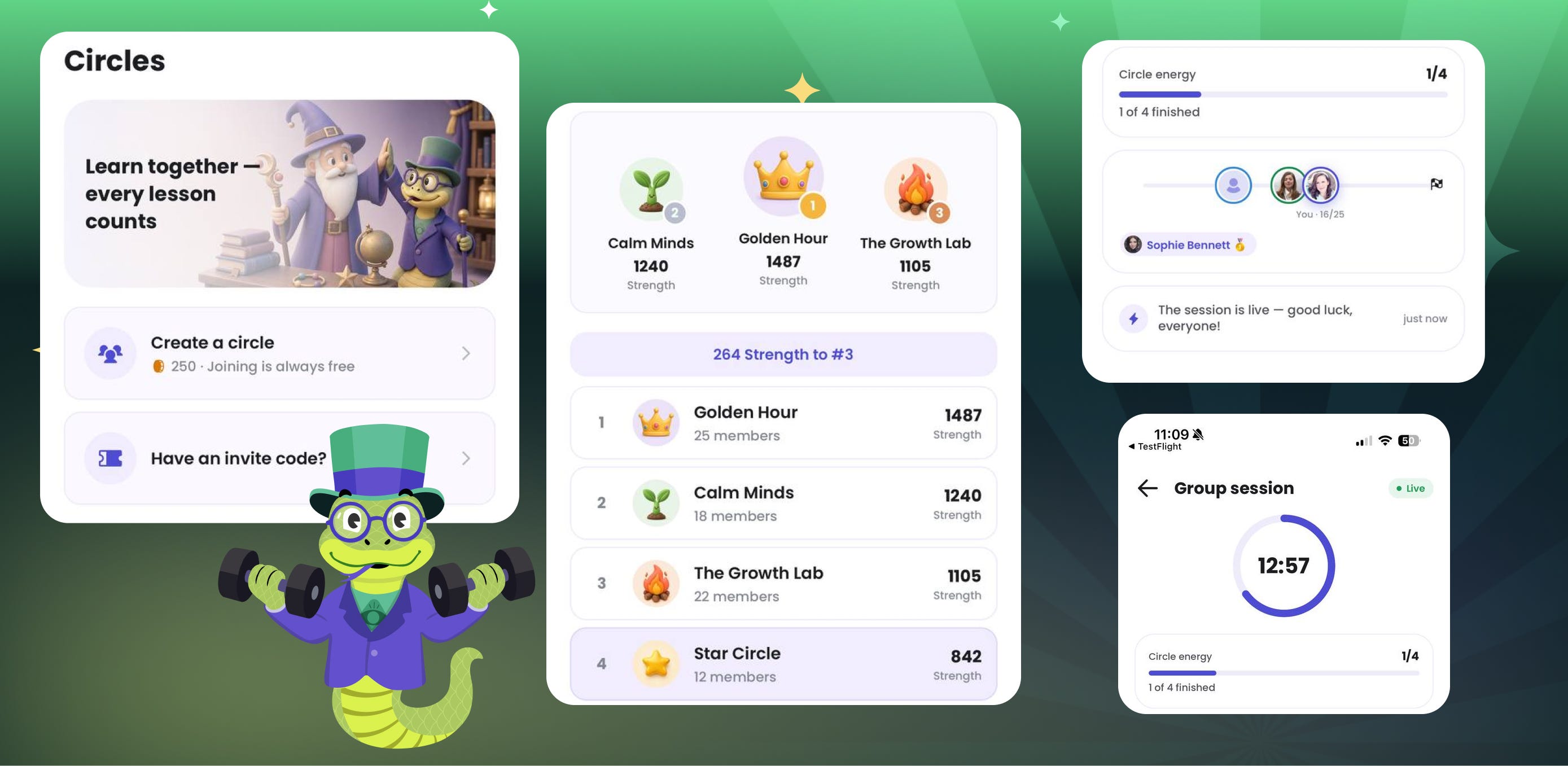
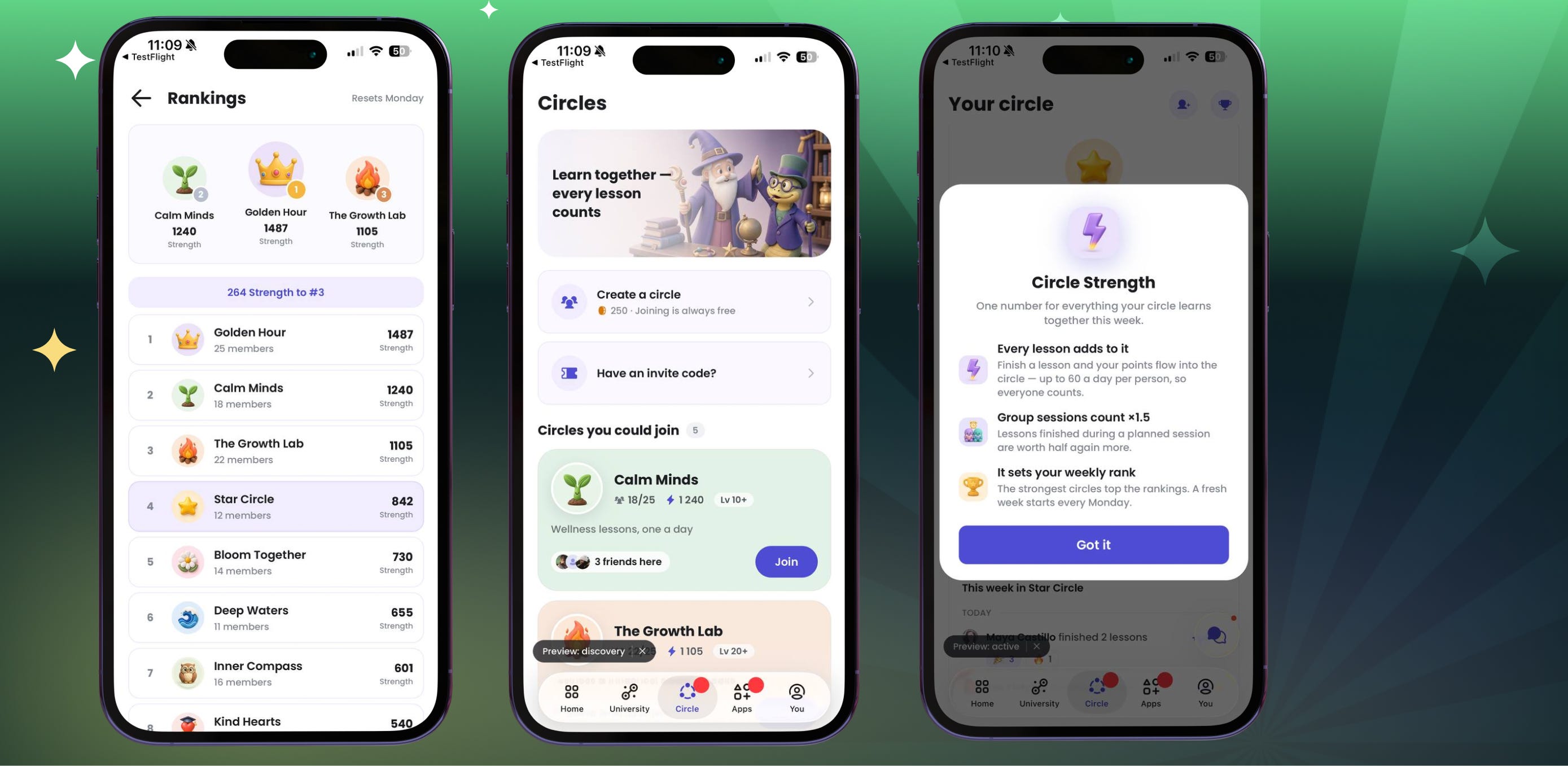
A Circle is a small group inside Astra Trainer that learns together. Think of a guild, or a study group, or the four people from your course who ended up in the same corner of the library every Tuesday and somehow all passed.
You can start one, or join one that already exists. You do not need to arrive with friends. Most people do not.
Someone is expecting you
This is the whole thing, and it is smaller than it sounds.
Alone, a lesson can always be done later. Later is free. Later costs nothing at the moment you choose it, which is exactly why it is so easy to keep choosing.
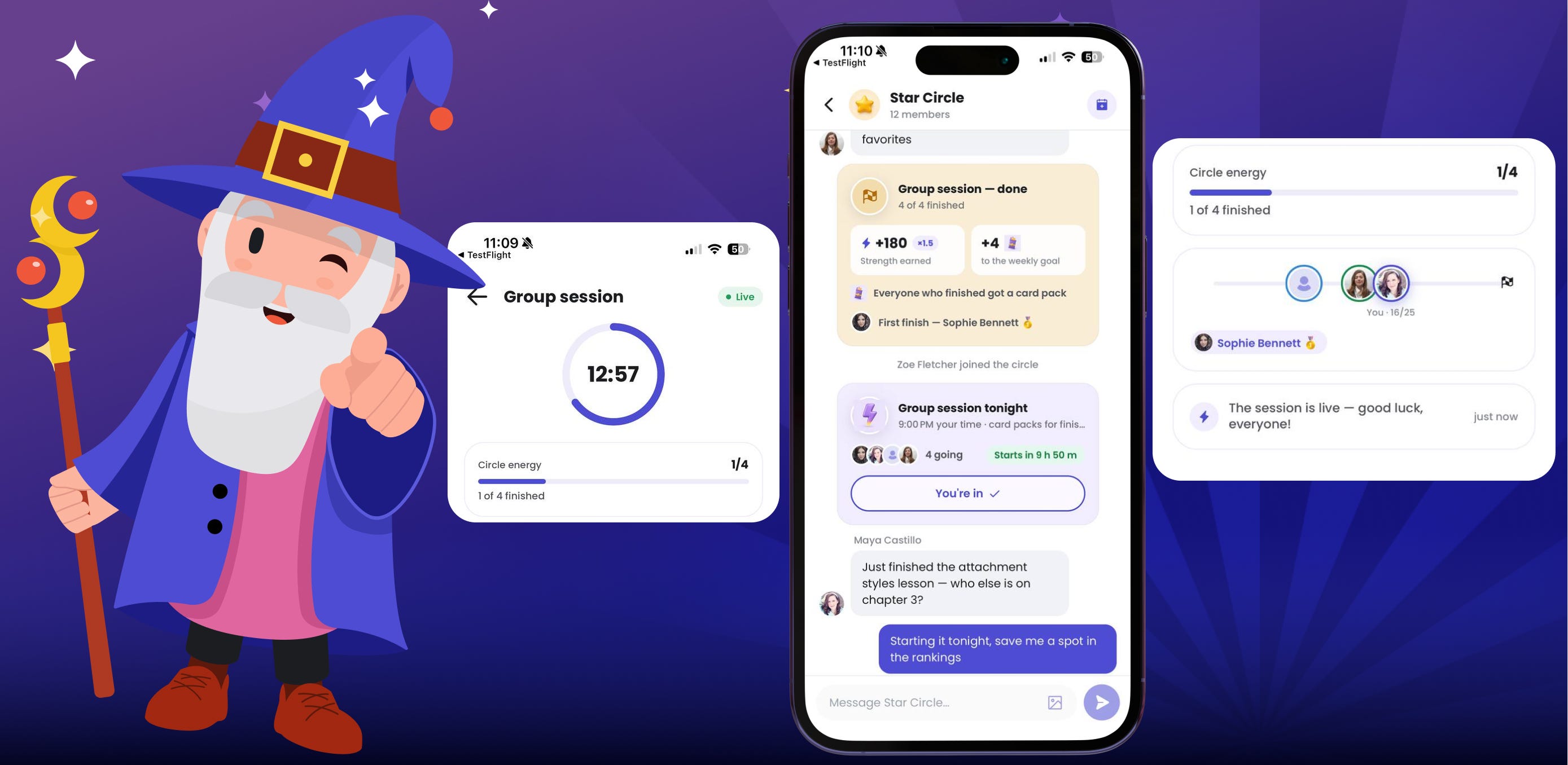
When a Circle agrees on a time, later stops being available. You do not have to want it more than you did yesterday. You just have to show up at a time you already agreed to, with people who will notice the empty seat. Then the lesson gets done, and you end the day slightly further along than you started it.
Which, over a year, is the only thing that has ever worked.
The talking is not a distraction from the learning
Think about school, or university, or any course you actually finished. Ask yourself honestly what you remember. Some of it is the material. Most of it is the people: the running joke, the person who always had the good notes, the group chat that was ninety percent nonsense and ten percent the thing that got you through the exam.
That is not a failure of studiousness. Wanting to be around your own kind is not a distraction from learning, it is the fuel supply. We built Circles with the chat in the room rather than bolted on afterwards, because a study group where nobody talks is just a calendar invite.
You can join one on your own
Worth saying plainly, because it stops people before they start: you do not need to know anyone.
Astra Trainer is a learning app with a social layer, and one of the things that layer is for is meeting people who are studying the same thing you are. Join an existing Circle, say hello, do a lesson. That is the entire onboarding. Some of the most active Circles in the app are made up of people who arrived alone within a week of each other.
Twenty-five people, and not one more
Every Circle caps at twenty-five.
That number is a deliberate constraint, not a technical limit. Above a certain size a group stops being a group and becomes an audience: a few people talk, everyone else reads, and the thing that made it work quietly dies. Twenty-five is small enough that your absence is noticeable and your arrival is welcomed, which are the two properties that actually do the work.
Quality of attention beats quantity of members. We would rather you were one of twenty-five than one of a thousand.
Your lessons score, and the week resets
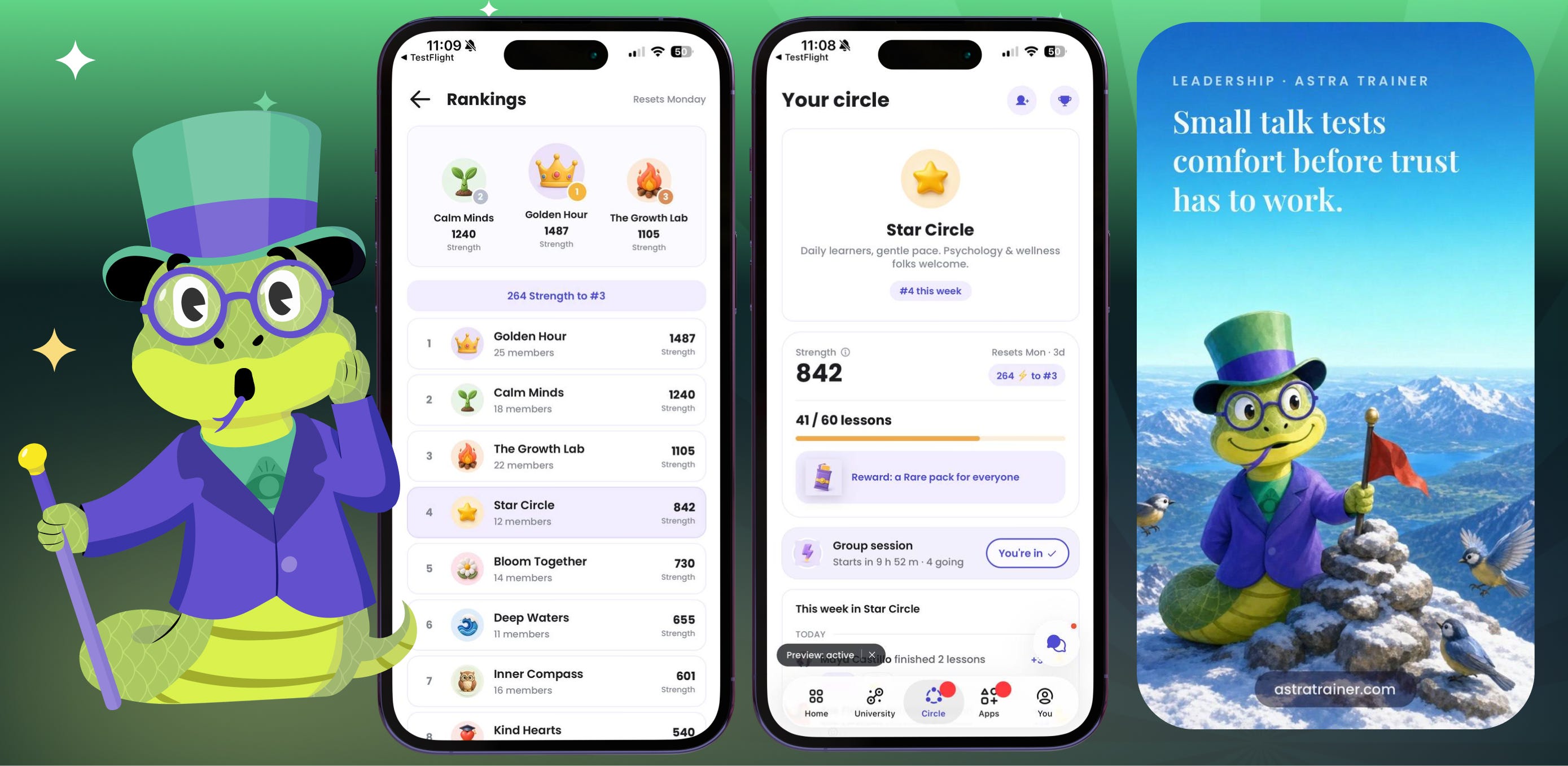
Every lesson anyone in your Circle completes adds points to the Circle’s total. It does not matter whether you did it together in a live session or on your own on a train at seven in the morning. It counts either way.
Circles run on a weekly cycle. At the end of it, the top Circle takes the reward, and everything resets.
This is the part that connects straight back to that study. Your effort is no longer only about you. The Monday lesson you nearly skipped is now three points your Circle does not get, and something in the brain treats that very differently from a promise you made only to yourself. It is the same mechanism that made the third group cycle for twenty-two minutes instead of ten, and it is doing the same job here.
The weekly reset matters too. A season that never ends is exhausting. Seven days is short enough that a bad week is genuinely over on Monday, and nobody is ever so far behind that catching up looks pointless.
What a Circle will not do
It will not want it for you. If you join one and never open it, you will have joined a group chat and nothing else. Circles lower the cost of showing up, they do not remove it.
It also will not fix a subject you do not actually care about. Company makes a hard thing sustainable. It does not make a boring thing interesting. Pick something you would be curious about anyway, then bring people to it.
And a Circle is not a substitute for the quiet solo work. Plenty of the best learning still happens alone at a kitchen table. The point is not to replace that. The point is that the solo work survives longer when someone is expecting you on Thursday.
The actual argument
An hour of scrolling and an hour in a Circle both pass at the same speed. That is the uncomfortable part. The difference is what is left at the end of it.
After the scroll you have consumed something, felt briefly informed, and retained close to nothing. Tomorrow the feed will be full again and it will ask for the same hour. It is designed to. That is not a moral failing on your part, it is a well-built product doing its job, and we have written about that before.
After an hour in a Circle you know something you did not know at lunchtime, a few people know your name, and the whole thing is marginally easier to do again tomorrow. That last part compounds. Nothing on the feed compounds.
If you were here in July, you already read the short version of this. That was the founder note written the week we shipped Circles, and it is still worth a minute: I Watched People Quit Learning in Silence. This is the full account, with the research that explains why it works.
We are not trying to make Astra Trainer the thing you spend the most time in. We are trying to make it the thing you are still doing in March.
Related: Doomscrolling Won't Make You Smarter · Battles, Streaks & Reputation · Your First 7 Days · We Grew You a Tree